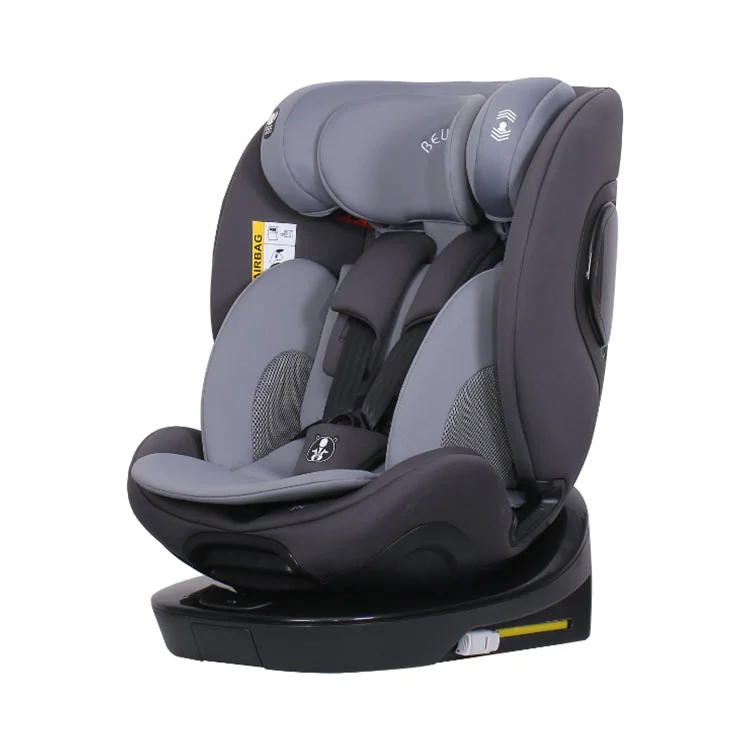
The usual advice is "try it in your car before you buy." True, and useless if you are ordering online or stocking a container. So here is what actually decides whether a seat fits — five things about the vehicle, not the seat.
Quick Answer Fit is decided by the car, not the seat. Check five things: whether the seating position has ISOFIX anchors, whether it has a top tether anchor, whether the floor is solid or hides an underfloor storage bin, how much front-to-back room there is for a rear-facing seat, and the width if you need more than one seat side by side. Also confirm the seat's approval type: an i-Size universal seat fits any i-Size marked position, while a vehicle-specific approval comes with a compatibility list you must check.
Almost every "this seat doesn't fit" problem traces back to a mismatch nobody checked. The seat was fine. The car was fine. They were simply not designed against the same assumptions.
We build the same seat in two anchoring versions for exactly this reason. Here is what to look at.
Why trust this guide: Bewell has manufactured child car seats in Ningbo since 2015 and exports to more than 40 countries. Fitment is a daily engineering problem for us — it is why our range includes both support-leg and top-tether versions of the same seat, and why we ask distributors what people drive in their market before recommending a model.
This single distinction answers most fit questions before you measure anything, and it is widely misunderstood.
Under ECE R129, a seat can be approved two ways:
i-Size universal. The seat is built to a standard envelope, and it fits any vehicle seating position marked with the i-Size symbol. No vehicle list to check. This is the simple option.
Vehicle-specific. The seat is fully R129 approved but does not fit the universal envelope. It comes with a list of compatible vehicles, and you must confirm your car is on it.
Both are legal and both are safe. They just place the burden of checking in different places. If you want compatibility to be someone else's problem, buy i-Size universal. More on the standard is in our R129 guide.
Every i-Size seat is R129. Not every R129 seat is i-Size universal. The difference is a vehicle list.
01Does the position have ISOFIX anchors?
ISOFIX anchors are two metal bars built into the vehicle where the seat back meets the seat base. Most modern cars have them at the two outer rear positions. Many do not have them in the centre rear position.
How to find them: look for a small symbol on the seat back or a plastic marker in the crease, then feel into the gap. Your vehicle manual will confirm which positions have them.
If a position has no anchors, that does not rule out a car seat. It rules out an ISOFIX install there. Belt-installed seats exist precisely for this, and R129 covers them — see our installation comparison.
02Is there a top tether anchor, and where?
A top tether needs a dedicated anchor point behind the seating position. Location varies more than people expect — on the rear shelf, on the seat back, on the cargo floor, or on the ceiling, depending on body style. Some positions have none.
This matters because an ISOFIX seat needs a third anchor to stop it pitching forward in a crash. If the position has no tether anchor, you need the other kind of third anchor: a support leg.
03What is under the floor?
Here is the check almost nobody performs, and the one that causes real danger.
A support leg works by bracing against the vehicle floor and passing crash force into it. Some cars — often MPVs and SUVs — have an underfloor storage compartment right where that leg would land. The lid is a thin panel over a void. In a crash it can collapse, and the leg loses the floor it was relying on.
Never plant a support leg on a storage-bin lid. If your seating position has underfloor storage, choose a top-tether seat instead. This is not a preference. It is the difference between a working third anchor and a decorative one.
The reverse case exists too: a car with a solid floor but no tether anchor at that position needs a support-leg seat. Which is why we make both. The full comparison is in support leg vs top tether.
A support leg needs solid floor beneath it. A top tether needs an anchor behind. Your car decides which you can use.
04Is there room for rear-facing?
Rear-facing seats need front-to-back space, and this is where small cars run out first. Three things interact:
The front seat position. A rear-facing seat may push the front seat forward. If the driver cannot then reach the pedals comfortably, that is not a fit.
The recline angle. A newborn needs a proper rear-facing recline for head and airway support. A seat squeezed in at the wrong angle is not installed correctly, even if it physically fits.
The vehicle seat contour. Car seats are quite sculpted. A heavily bolstered or steeply sloped vehicle seat can stop a car seat sitting flat.
Rotating all-stage seats also tend to be taller and bulkier, because of the base underneath. In a small car with a low roofline, check headroom for the child at the top of the height range, not just today.
05How wide is the seat, and how many do you need?
Width only matters when you need more than one seat across the back — but then it matters completely.
Two car seats plus an adult, or three car seats side by side, is one of the hardest fitment problems there is. The rear bench has a fixed width. Buckles need room to operate. Seats with wide side wings eat space fast.
From the factory floor — where 44 cm comes from
R129 sets a maximum width of 44 cm for the i-Size booster category. That number is not arbitrary. It exists so that a reasonable number of seats can sit side by side in a normal vehicle bench.
For families needing three across, that constraint is doing quiet work in the background. When you compare boosters, a narrower shell is a real functional advantage — not a sign of less protection, as long as the seat is R129 approved with side-impact testing.
Practical order for three across: put the narrowest seats where buckles are tightest, and check that every buckle can still be operated with the neighbouring seats installed. Booster types and widths are covered in high-back vs backless.
The one rule with no exceptions
Never install a rear-facing seat in front of an active airbag. An airbag deploys with enough force to be fatal to a rear-facing child at that distance. Either deactivate the airbag for that position, or use a rear seat.
The rear seat is safer anyway, and several countries require it for younger children. Rules by country are in our certification and laws guide.
A five-minute check before you buy
Check these in your own car, in this order
Check
Where to look
If the answer is no
ISOFIX anchors at the position
Crease between seat back and base; vehicle manual
Choose a belt-installed seat
Top tether anchor
Rear shelf, seat back, cargo floor or ceiling; vehicle manual
Choose a support-leg seat
Solid floor, no storage bin
Lift the floor mat and look
Choose a top-tether seat
Front-to-back room for rear-facing
Sit in the driver's seat after a trial fit
Consider a more compact model
Width, if fitting more than one
Measure the bench; check buckle access
Look for narrower shells
i-Size universal or vehicle-specific
The seat's approval label and manual
Check your car against the vehicle list
Two habits make this reliable. Read the vehicle manual, not just the seat manual — it is the definitive map of what anchors exist and where. And do the trial fit with the driver's seat adjusted to its normal position, not slid forward to make things work.
For distributors: fit is a returns problem
If you sell rather than drive, compatibility is not a technical footnote. It is a direct cost.
"It doesn't fit my car" is one of the most common reasons a car seat comes back — and unlike a defect, it is entirely predictable from the vehicle fleet in your market. Some regions have a high share of vehicles with underfloor storage. Others have older cars missing tether anchors at some positions.
From the factory floor — what we ask buyers
When a distributor tells us their market, one of the first questions we ask is what people there drive. It changes the recommendation.
The practical answer for most markets is to stock both anchor types. That is why we keep near-twin models — the same seat, one with a support leg, one with a top tether. You cover almost any vehicle without doubling your range, and you stop turning away every customer whose car needs the other version.
It is also worth putting the fitment checks above into your own product pages and packaging. A customer who checks before buying does not become a return.
Check whether the seating position has ISOFIX anchors and a top tether anchor, whether the floor is solid or hides a storage bin, whether there is front-to-back room for rear-facing, and the width if you need more than one seat. Then confirm whether the seat is i-Size universal or has a vehicle-specific list.
What does i-Size universal mean?
It means the seat is built to a standard envelope and fits any vehicle seating position marked with the i-Size symbol, with no vehicle list to check. R129 also allows vehicle-specific approvals, which come with a compatibility list.
Can I use a support leg if my car has underfloor storage?
No. The leg must not rest on a hollow storage lid, which can collapse in a crash. Use a top-tether seat in that position instead.
Does every car have ISOFIX in the middle seat?
Often not. Many cars have ISOFIX only at the two outer rear positions. Check the vehicle manual, and use a belt-installed seat if the centre position has no anchors.
Can I fit three car seats across the back?
Sometimes, depending on the width of the vehicle bench and the seats. Narrower shells help, and every buckle must still be reachable once all seats are installed. R129 caps the i-Size booster category at 44 cm wide partly for this reason.
Can a car seat go in the front seat?
Never put a rear-facing seat in front of an active airbag. The rear seat is safer in general, and some countries require younger children to travel in the rear.
About Bewell
Ningbo Bewell Baby Products Manufacturing Co., Ltd. has manufactured child safety seats since 2015. Our Ningbo factory runs in-house mold making, blow and injection molding, sewing, assembly and inspection, with an annual capacity of 200,000+ seats. Every model is certified to ECE R129 (i-Size); we hold China 3C certification and ISO 9001, and produce both support-leg and top-tether versions so distributors can cover the vehicles in their market.
We use cookies to offer you a better browsing experience, analyze site traffic and personalize content. By using this site, you agree to our use of cookies.
Privacy Policy