

Every ISOFIX seat needs a third anchor to stop it tipping forward in a crash. There are only two ways to add it — a leg to the floor, or a strap to an anchor. We build both, so here's how to pick.
An ISOFIX seat clicks onto two rigid anchor bars at the base of the car seat. That holds the bottom of the seat firmly — but on its own, the top of the seat can still swing forward in a crash, pivoting on those two lower points. That forward pitch is dangerous, so every ISOFIX seat adds a third anchor to stop it. Under ECE R129 (i-Size), that third anchor is either a support leg or a top tether. This guide explains both.
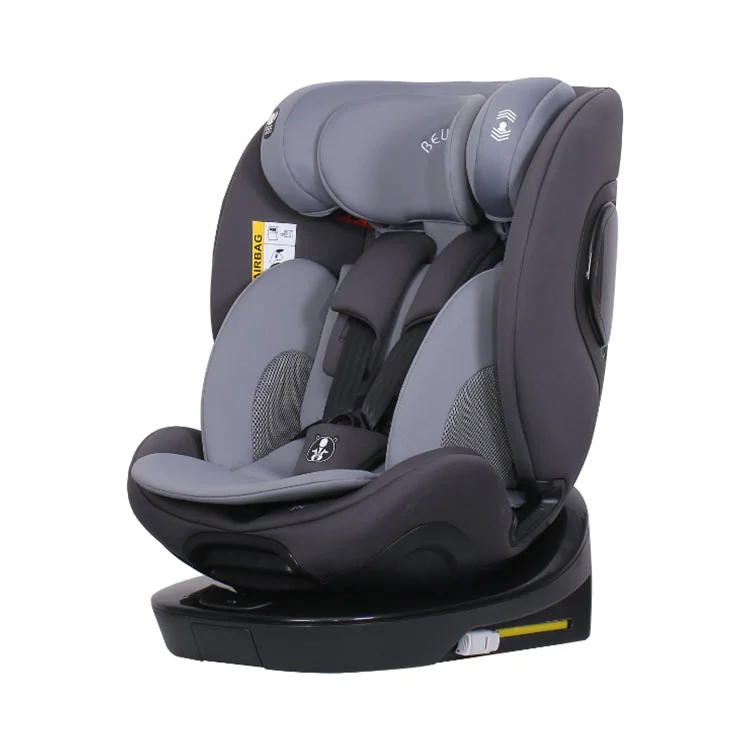
01Why an ISOFIX seat needs a third anchor
Picture the seat held only by its two lower ISOFIX points. In a frontal crash, the child and seat throw forward. The base stays clipped, but the top of the seat rotates down and forward around those two points — like a door swinging on its hinges. That rotation moves the child's head a long way, fast.
The third anchor stops the swing. It ties the seat to the car at a second height or a second surface, so the seat can't pivot. Both methods below achieve this. The difference is where they anchor.
02How a support leg works
A support leg (also called a load leg) is a telescoping leg that drops from the front of the seat base down to the floor of the car. With the two ISOFIX points, it forms a stable triangle — three points that can't fold. In a crash, the leg passes the forward force straight down into the car's floor pan instead of letting the seat rotate.
The rule we build around: the leg only works if it firmly touches the floor. A leg resting an inch above the carpet does nothing. That's why our support-leg models — BW25 and BW22 — use a telescoping leg you pull out and lock, with a green/red indicator: green means it's seated on the floor and loaded, red means it isn't there yet.
When the leg isn't in use, it folds back and hides into the base. And because it's adjustable in height, one seat fits cars with different floor depths.
03How a top tether works
A top tether is a length of strong webbing with a hook, attached to the top of the seat back. You run it over the top of the vehicle seat and clip the hook to a dedicated tether anchor point in the car, then pull it tight. Now the seat is tied at three points — the two lower ISOFIX bars plus the upper tether — so it can't rotate forward. The tether also absorbs some crash energy as it takes the load.
Our top-tether models — BW23 and BW17 — pair the tether with ISOFIX to lock the seat into that three-point form. Like the leg, a good tether has a tightness indicator so you can see it's pulled snug, not loose.
04The real decision: it's about the car, not the seat
Here's the part that matters, and the part most guides skip. Neither method is safer in a crash — both are approved and both stop the rotation. What changes is which one your car can actually take.
| Support leg | Top tether | |
|---|---|---|
| Anchors to | The car floor | A tether anchor point behind the seat |
| Your car needs | A solid, flat floor | A tether anchor at that seat |
| Can't be used when | There's an underfloor storage bin — the leg must not rest on a hollow lid | The seating position has no tether anchor |
| Install feel | Pull leg down, lock, check green | Route strap, hook, pull tight, check green |
| Frees up | No strap to route | No leg in the footwell |
Ask what cars your customers drive, not which system sounds stronger. The best anchor is the one their vehicle is built for.
05Which Bewell models use which
All of these are R129-certified 360° or all-stage seats with ISOFIX, a 5-point harness, and side-impact protection. They split by third anchor:
| Model | Third anchor | Range | Notes |
|---|---|---|---|
| BW25 | Support leg | 40–150 cm | Flagship; blow + injection build |
| BW22 | Support leg | 40–150 cm | Lightest rotating model |
| BW23 | Top tether | 40–150 cm | For cars without floor space for a leg |
| BW17 | Top tether | 76–150 cm | Lighter forward-facing option |
Between BW22 and BW23 you have the same seat, two anchors — pick by the cars in your market. Browse the whole 360 rotating range to compare.
06Why a distributor should offer both
This is the sourcing angle a parent never thinks about, but a buyer should. Car fleets differ by market. Some regions have lots of vehicles with underfloor storage where a support leg won't sit; others have older cars missing tether anchors at some seats.
If you only stock one anchor type, you turn away every customer whose car needs the other — and you invite "it doesn't fit my car" returns. Carrying a support-leg model and a top-tether model side by side lets one lineup fit almost any vehicle in your market. That's why we keep BW22 and BW23 as near-twins: same seat, so you can offer both without doubling your range. We help buyers pick the mix on our customization page.
07Installing each one right
Both are simple, but each has one step people miss.
- Support leg: click in the ISOFIX, then pull the leg down until it sits firmly on the floor and the indicator turns green. Don't leave it short of the floor, and never rest it on a storage-bin lid.
- Top tether: click in the ISOFIX, route the strap over the vehicle seat to the correct anchor point (check your car manual for its location), hook it, and pull until the indicator shows tight. A loose tether barely helps.
New to how ISOFIX itself compares with a plain seat-belt install? See our ISOFIX vs seat belt guide. For where these seats sit in the full lineup, start with our guide to car seat types, or tell us your market and we'll match the anchor to it.
Common questions
Is a support leg or top tether safer?
Neither. Both are approved third anchors under R129 and both stop the seat pitching forward. The right choice depends on your car — a support leg needs a solid floor, a top tether needs an anchor point.
Can I use a support leg with underfloor storage?
No. If the seating position has an underfloor storage compartment, the leg must not rest on the hollow lid, which can collapse in a crash. Choose a top-tether seat for those cars.
Does every car have a top tether anchor?
Most modern cars have tether anchors at the rear seats, but the location varies and some positions (often the center seat) may not have one. Check your vehicle manual before choosing a top-tether seat.
Do I need a third anchor at all with ISOFIX?
Yes. The two lower ISOFIX points alone let the seat rotate forward in a crash. The third anchor — leg or tether — is what stops that, and R129 seats include one.
Sources
- UNECE — Regulation No. 129 (i-Size): support leg or top tether as the third anchorage
- NHTSA — Car Seats and Booster Seats: lower anchors and tether guidance
- Bewell product pages — BW25, BW22 (support leg); BW23, BW17 (top tether)
General guidance only. Always follow the seat's manual and your vehicle owner's manual, and check the approval label and anchor points before installing.