

Open any store shelf or supplier catalog and the names start to blur. Convertible. All-in-one. Group 1/2/3. High-back. Backless. Half of them seem to overlap, and no one explains where one type ends and the next begins.
They overlap because the child keeps changing. A car seat has one job: hold a child the right way for their size, right now. As the child grows, the right way changes — and that is what splits car seats into types. Sort the types by size and the whole picture gets simple.
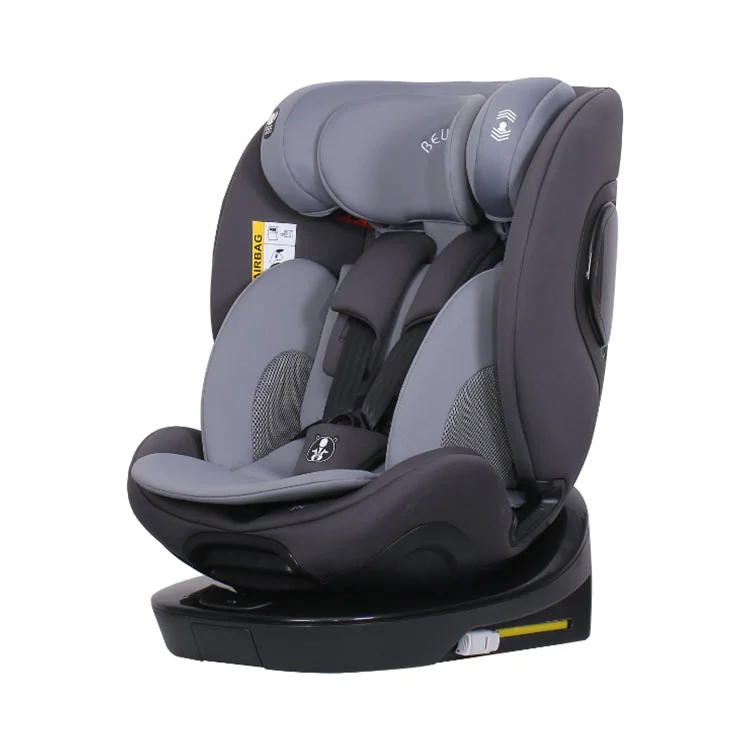
How Car Seats Are Sorted: Height, Weight, and Age
Before the types make sense, you need to know how seats get grouped. There are two systems, and they use different rulers.
The older system, ECE R44, sorted seats by the child's weight — groups 0, 0+, 1, 2, and 3. The newer system, ECE R129 (i-Size), sorts them by height instead. Height is easier to measure and gives a closer fit, so R129 has replaced R44 for new seats across Europe. If you sell into regulated markets, R129 is the standard that matters now. We cover the full difference in our i-Size vs R44 guide.
Under R129, a full range runs from 40 cm to 150 cm. That range breaks into four size stages. Age is only a rough guide — always go by height first. You can shop our range the same way sellers sort it: by age, by weight, or by height.
| Height | Rough age | Best-fit seat type |
|---|---|---|
| 40–76 cm | Birth to ~9 months | Rear-facing seat, or an all-stage seat that starts at 40 cm |
| 76–100 cm | ~9 months to 4 years | Forward-facing harness seat, or all-stage seat |
| 100–125 cm | ~4 to 6 years | High-back booster |
| 125–150 cm | ~6 to 12 years | High-back or backless booster |
The Five Main Types of Car Seats
Every car seat on the market is a version of one of these five. Here is what each does, how it installs, and where it fits.
1. Rear-facing infant seats
The first seat a baby uses. It faces the back of the car, which is the safest way for a newborn to ride: in a crash, the shell cradles the head, neck, and spine together instead of letting the head snap forward. It suits children from about 40 cm up to 76–85 cm.
Many ranges use a small carrier that clicks onto a base. Bewell takes a different path: our all-stage rotating seats start at 40 cm and ride rear-facing from birth, so one seat covers the newborn stage and every stage after it. For a distributor, that means fewer SKUs to stock and a longer use life to sell.
2. Convertible / all-stage 360° rotating seats
The most flexible type. It rides rear-facing for a baby, then turns to face forward as the child grows — one shell, the whole journey from 40 cm to 150 cm (about 0 to 12 years). The 360° rotating base spins toward the door so you can load a child without bending into the car.
These install with ISOFIX plus a support leg or top tether to stop the seat from tipping in a crash. In our range: BW25 and BW22 use a support leg; BW23 uses a top tether. It is the single best "cover everything" product for a catalog.
3. Forward-facing seats with a 5-point harness
For children who have outgrown rear-facing but are still too small for a booster — roughly 76 cm to 150 cm, or 9 months to 12 years. A 5-point harness holds the child at the shoulders, hips, and between the legs, which spreads crash force across the strongest parts of the body.
Bewell's BW26 installs with a car belt plus top tether; BW17 uses ISOFIX plus top tether. Both are lighter, forward-only seats — a good value tier below the rotating all-stage models.
4. High-back boosters
Once a child is big enough for the adult seat belt, a booster lifts them so the belt crosses the right spots — flat across the hips, not the soft belly, and over the middle of the shoulder, not the neck. A high-back booster adds a winged headrest for side-impact protection and better sleep support. It fits roughly 100–150 cm (4–12 years).
Bewell's BW16 adds memory foam in the headrest and back. BW15 has a detachable backrest, so one product turns into a backless booster as the child grows — two seats in one box.
5. Backless boosters
The last seat before a child rides on the plain seat belt alone. It is just a cushion that raises the child so the belt fits, for about 125–150 cm (6–12 years). Backless boosters are the lightest, cheapest, and easiest to move between cars — but they give the least side protection, so they suit older, taller kids. Bewell's BW29AB is a wide-space backless booster that installs with the car belt, or with ISOFIX connectors plus the belt.
| Type | Height | Rough age | Direction | Key benefit |
|---|---|---|---|---|
| Rear-facing infant | 40–76 cm | 0–9 mo | Rear | Safest for newborn head & neck |
| All-stage rotating | 40–150 cm | 0–12 yr | Rear + forward | One seat for every stage; easy loading |
| Forward-facing harness | 76–150 cm | 9 mo–12 yr | Forward | Full harness at a lower price |
| High-back booster | 100–150 cm | 4–12 yr | Forward | Belt fit + side-impact head wings |
| Backless booster | 125–150 cm | 6–12 yr | Forward | Light, cheap, easy to move |
360° Rotating Seats: A Category of Their Own
Rotating seats are technically all-stage convertibles, but buyers now shop for them by name — so it helps to treat them as their own group. The draw is simple: the seat spins to face the open door, the child goes in upright, and the seat turns back to travel. No twisting a baby into a fixed shell.
The spin also makes it easy to switch a seat from rear-facing to forward-facing at the right stage, instead of buying a new seat. For markets where parents keep one child in one seat for years, this is the product that sells itself.
The Installation Types Behind Every Seat
Every type above installs one of a few ways. These are not seat types — they are the methods that hold any seat in place.
- ISOFIX / LATCH: rigid connectors that click straight onto anchor bars built into the car. They cut fitting mistakes because you hear and see the lock.
- Top tether: a strap from the top of the seat to an anchor point, which stops the seat from pitching forward in a crash.
- Support leg (load leg): a leg that braces down to the vehicle floor, so crash energy goes into the floor instead of rotating the seat.
- Vehicle seat belt: the seat is held by the car's own belt. Works in nearly every car, which is why boosters rely on it.
Wondering whether ISOFIX or the seat belt is safer? Neither wins on its own — it comes down to a correct, tight install. We break it down in our installation guide.
| Method | Holds the seat by | Common on |
|---|---|---|
| ISOFIX | Rigid anchors in the car | All-stage, harness, high-back seats |
| Top tether | An upper strap | Forward-facing harness seats |
| Support leg | A leg to the floor | Rotating & infant stages |
| Seat belt | The car's own belt | Boosters, backless boosters |
One Detail Buyers Miss: Injection vs Blow Molding
Two seats can look alike and be built two different ways. The molding method changes cost, weight, and how the shell handles a crash — and most buyers never ask about it.
- Injection molding presses plastic into a solid, precise shape. It gives a clean finish and a strong, exact structure — good for boosters and injection-molded seats. Bewell uses it on BW26, BW16, and BW15.
- Blow molding forms a hollow shell. The hollow walls help absorb and spread crash energy, and the tooling suits larger single-piece shells. We use it on the rotating BW22, BW23, and the BW29AB booster.
Neither is "better." They do different jobs, and a strong range uses both — the way ours does. Some seats, like our BW25, even combine both methods in one shell.
Matching a Type to Your Market
The right mix of types depends on where you sell. A few patterns we see across 40+ export markets:
- Regulated, safety-first markets (EU, Japan, Korea): lead with R129 all-in-one convertible seats and high-back boosters. Rear-facing capability and side-impact wings are the questions buyers ask first.
- Price-sensitive and hot-climate markets: pair a value harness seat with a backless booster, and favor breathable fabric.
- Wide-range distributors: stock one seat per stage — rotating, harness, high-back, backless — so a family can buy from you at every age.
FAQs
What type of car seat does my child need?
Go by height, not age. Measure the child: 40–76 cm needs a rear-facing seat, 76–100 cm a forward-facing harness seat, 100–125 cm a high-back booster, and 125–150 cm a high-back or backless booster. An all-stage seat covers the whole range in one shell.
What is the difference between a convertible and an all-in-one car seat?
A convertible seat switches between rear-facing and forward-facing. An all-in-one (all-stage) seat does that and turns into a booster later, covering birth to about 12 years. All-in-one is the longer-lasting of the two.
Is a 360° rotating car seat worth it?
For daily use, yes — it spins to the door so you can load a child without bending, and it makes switching from rear- to forward-facing simple. The trade-off is a higher price and more weight from the reinforced base.
At what age can a child use a backless booster?
Around 6 years and 125 cm, once the child is tall enough for the seat belt to sit flat on the hips and across the middle of the shoulder. Younger or shorter children need a high-back booster for side protection.
What's the difference between injection and blow-molded car seats?
Injection molding makes a solid, precise shell with a clean finish. Blow molding makes a hollow shell that helps absorb and spread crash energy. Neither is safer by default — both are used across quality ranges for different seats.
Do all of these types meet R129?
They can, and every Bewell type does. R129 (i-Size) covers infant, all-stage, harness, high-back, and backless seats. Always check for the orange approval label and the height range printed on it.
The Bottom Line
Five types, one rule: match the seat to the child's height. Start rear-facing, move to a forward harness, then to a high-back booster, then to a backless booster — or skip the guesswork with an all-stage rotating seat that does the whole journey.
Every Bewell seat ships certified to ECE R129 with side-impact testing built in. Browse the full range by age, weight, or height, or ask us which mix fits your market.
Sources
- UNECE — Regulation No. 129 (Enhanced Child Restraint Systems / i-Size)
- UNECE — Regulation No. 44 (Child Restraint Systems, superseded for new sales)
- NHTSA — Car Seats and Booster Seats: types and fitting guidance
- Bewell 2026 Product Catalogue — model ranges, standards, and installation methods
This article gives general guidance. Always follow the seat's manual and your vehicle owner's manual, and check the approval label before installing.