

Anyone who has leaned into a back seat with a squirming toddler knows the problem. You twist, the child twists the other way, and your lower back pays for it. A rotating car seat fixes that one moment: the seat spins to meet you at the open door, the child sits down facing out, and the seat turns back to travel.
That sounds small. In daily use, it is not. But rotating seats also cost more and weigh more, and a lot of parents ask the same fair question first — is the spin safe? This guide gives you the honest version: what these seats do well, where they fall short, and how to tell a good one from a gimmick.
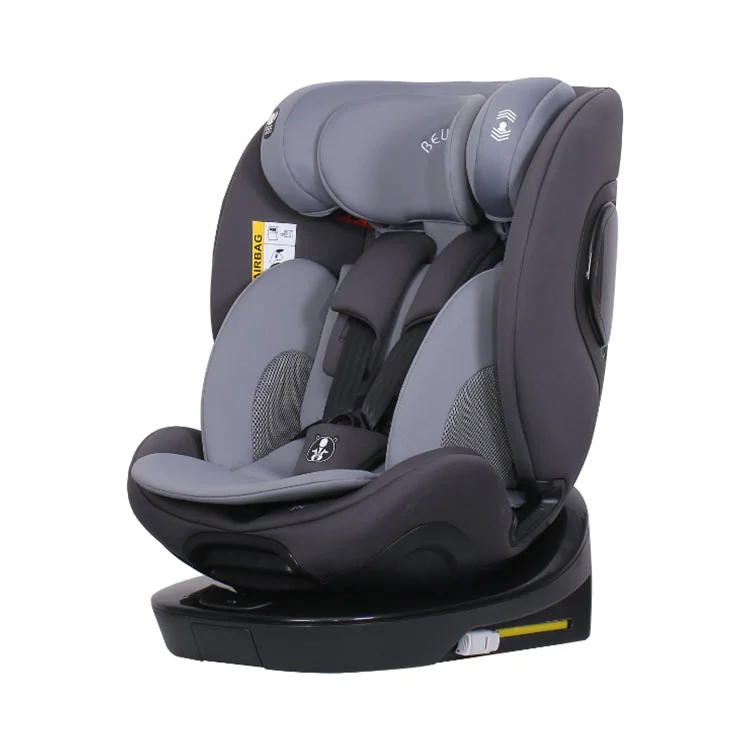
What a 360 Rotating Car Seat Actually Does
A rotating seat sits on a base that turns. Most turn a full 360°, though the part you use every day is the 90° swing toward the door. You unlock the seat, spin it to face you, buckle the child, and spin it back until it clicks into the travel position.
Almost every rotating seat is also an all-stage seat. It rides rear-facing for a baby, then faces forward as the child grows — one shell from 40 cm to 150 cm, or about birth to age 12. For the full map of seat types, see our guide to car seat types.
The Real Benefits
- Easier loading, every single day. The seat comes to you. No bending deep into the car, no twisting a child into a fixed shell. Parents with back trouble feel this the most.
- You keep a child rear-facing longer. Rear-facing is the safest way for a young child to ride, but it is awkward to load. When the seat spins, that excuse disappears — so families tend to keep the baby rear-facing to the age the rule intends.
- One seat for every stage. Because it is all-stage, you buy once instead of three times. That means fewer seats to fit, and for a store, fewer SKUs to stock.
- Quick, correct direction changes. Switching from rear- to forward-facing is a turn of the seat, not a re-install. Fewer install steps means fewer install mistakes.
The Trade-offs
A rotating seat is not the right pick for everyone. Here is the other side.
- It costs more. The turning base and the reinforced frame add parts, and parts add price.
- It weighs more. A forward-only seat can weigh around 7.5 kg. A heavy rotating seat can reach about 12.5 kg. If you swap the seat between two cars a lot, that weight is real.
- It takes more space. The base is bigger, so a rotating seat is bulkier in a small back seat.
- More moving parts. A spin base has a lock that must work every time. On a cheap seat, that is where quality slips. On a good seat, it is engineered and tested — more on that below.
Is the Spin Safe?
This is the question that stops most buyers, so let's be direct. A rotating seat is as safe as any other seat when two things are true: it locks firmly in the travel position, and it passes crash testing in that position.
The spin only helps you load the child. During travel and in a crash, the seat is locked — it does not turn. What holds it steady is the same hardware other seats use: ISOFIX connectors, plus a support leg braced to the floor or a top tether. These stop the seat from rotating or pitching forward on impact. A good rotating seat also carries an alarm or clear indicator that warns you if it is not locked straight.
360 vs a Standard Convertible
A standard convertible does the same stage-to-stage job, minus the spin. Here is how they line up.
| 360 rotating seat | Standard convertible | |
|---|---|---|
| Loading | Spins to the door — easiest | Bend and twist into the car |
| Direction change | Turn the seat | Re-install the seat |
| Weight | Heavier (base + frame) | Lighter |
| Price | Higher | Lower |
| Moving between cars | Less handy | Easier to move |
| Stage coverage | Birth to ~12 yr | Birth to ~12 yr |
Choose a rotating seat if the seat lives in one car and you use it daily. Choose a standard convertible if you move it between cars often, want to save money, or need the lightest seat.
What to Look for in a Good One
If you decide a rotating seat is right, this is the checklist that separates a quality seat from a cheap one.
| Check | Why it matters |
|---|---|
| ECE R129 (i-Size) label | Confirms crash and side-impact testing |
| Firm lock + lock indicator | Tells you the seat is safe to travel |
| ISOFIX + support leg or top tether | Stops the seat rotating or tipping in a crash |
| Steel-framed base | Holds the spin mechanism together under load |
| Real rear-facing recline | A newborn needs a proper rear-facing angle |
| 5-point harness | Spreads crash force across the body |
Bewell's Rotating Range
All three of our rotating models are 360° all-stage seats (40–150 cm, about 0–12 years), certified to R129, with a 5-point harness, side-impact protection, and a steel-framed base. They differ in how they anchor and how much they weigh.
| Model | Anchoring | Molding | Weight | Best for |
|---|---|---|---|---|
| BW25 | ISOFIX + support leg | Blow + injection | 12.5 kg | Flagship pick; strongest build |
| BW22 | ISOFIX + support leg | Blow mold | 7.5 kg | The lightest rotating option |
| BW23 | ISOFIX + top tether | Blow mold | 12.5 kg | Cars without a floor space for a leg |
The choice between a support leg and a top tether comes down to the car. A support leg braces to the floor; a top tether uses an upper anchor. Both are proven anti-rotation methods — pick the one your vehicle is set up for. Not sure which fits your market? Ask us and we'll help you match the model.
FAQs
Are 360 rotating car seats safe?
Yes, when the seat locks firmly for travel and is crash-tested in that position. The spin only helps loading — in a crash the seat is locked and held by ISOFIX plus a support leg or top tether. Always check for the R129 label and a lock indicator.
Do 360 car seats need ISOFIX?
Most use ISOFIX plus a support leg or top tether, because rigid anchoring keeps the rotating base stable in a crash. Check that your car has ISOFIX anchor points before you buy.
Are rotating car seats heavier?
Usually, yes. The base and frame add weight — a rotating seat can reach about 12.5 kg, versus around 7.5 kg for a forward-only seat. Lighter rotating models exist, such as our 7.5 kg BW22.
Can a 360 seat be used rear-facing?
Yes. Nearly all rotating seats are all-stage seats that start rear-facing from 40 cm, then face forward as the child grows. The spin makes it easy to keep a young child rear-facing longer.
How long can a child use a 360 rotating seat?
An all-stage rotating seat covers roughly 40 to 150 cm, or birth to about 12 years — so one seat can serve the whole journey.
Is a rotating car seat worth the extra money?
If the seat stays in one car and you load a child daily, the easier loading and simple direction changes usually justify the price. If you move it between cars often or want the cheapest seat, a standard convertible may be the better buy.
The Bottom Line
A 360 rotating car seat buys you one thing above all: an easier back at the car door, every day, for years. For daily drivers who keep the seat in one car, that is worth the extra cost and weight. For families who swap cars or shop on price, a standard convertible does the same safety job for less.
Either way, safety comes from the label and the lock, not the spin. Browse our 360 rotating range, see the full lineup, or tell us your market and we'll point you to the right model.
Sources
- UNECE — Regulation No. 129 (Enhanced Child Restraint Systems / i-Size)
- NHTSA — Car Seats and Booster Seats: rear-facing guidance and installation
- Bewell 2026 Product Catalogue — BW25, BW22, BW23 specifications and installation methods
This article gives general guidance. Always follow the seat's manual and your vehicle owner's manual, and check the approval label before installing.