

2026-08-06
Most booster guides compare the two seats by price and by weight. We build them, so we'll compare them by the thing that actually keeps a child safe: where the seat belt lands, and what happens to it in a crash.
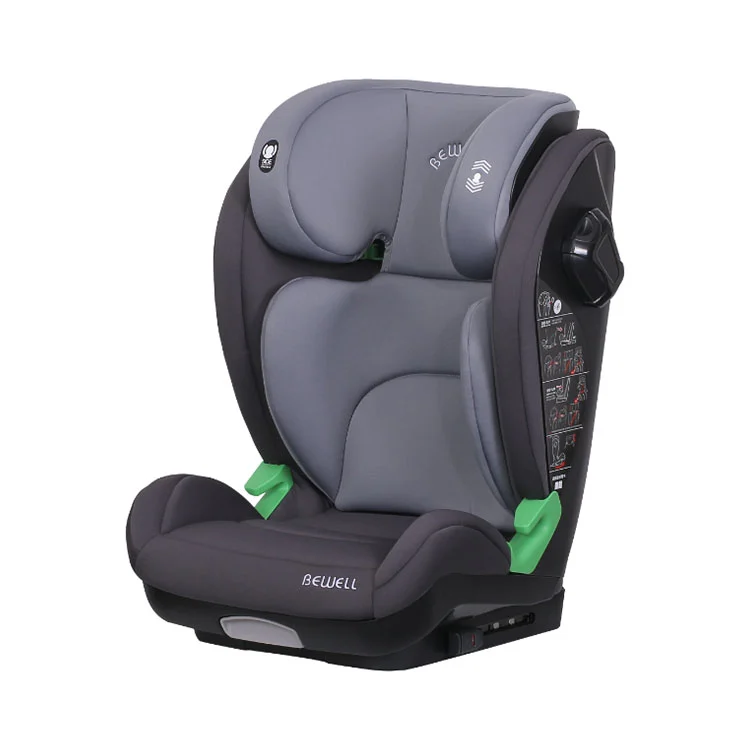
Here is the idea every good booster is built around, and the one most shoppers never hear: a booster is not a safety seat that catches the child. It is a device that makes the adult seat belt fit a small body. The belt does the catching. The booster's whole job is to put that belt in the right place — low across the hips, flat across the middle of the shoulder — and to keep it there when it matters.
Once you see a booster that way, the high-back-versus-backless question stops being about comfort or looks. It becomes a question about how much the seat helps the belt, and how much it protects the parts of the child the belt can't reach.
01What the belt has to do — and why height decides everything
A seat belt protects a child only when it crosses bone, not soft tissue. The lap belt should sit low on the hips, against the pelvis. The shoulder belt should cross the collarbone and the center of the shoulder. On an adult, the car is built for this. On a child, the lap belt rides up onto the belly and the shoulder belt cuts across the neck — both dangerous in a crash.
A booster fixes the geometry by raising the child and routing the belt. That is why every booster is sold by height, not age. Get the height wrong and the belt sits wrong, and the seat has failed at its one job — no matter how good it looks.
02The high-back booster: what the back actually buys you
A high-back booster does three things a backless one cannot:
- Side-impact protection. The winged headrest and torso sides carry energy-absorbing foam. In a side crash — the most dangerous kind for a child's head — those wings sit between the head and the door.
- A guided shoulder belt. The headrest has a belt guide that holds the shoulder strap at the right height as the child grows. You move the headrest up; the belt guide moves with it.
- Support for a sleeping child. This is the one parents underrate. A child asleep in a backless booster slumps sideways, and their body slides out of the belt path. A high-back shell holds them in position, so the belt still works if a crash happens while they doze.
Bewell's high-back boosters — BW16 and BW15 — cover roughly 100–150 cm (about 4–12 years), install with ISOFIX plus the car belt, and use an injection-molded shell with memory foam in the headrest and back. BW15 has one extra trick we'll come back to: its backrest detaches.
Shoppers hear "memory foam" and think safety. It isn't. The soft foam you feel in the headrest is comfort foam — it changes how the seat feels, not how it performs in a crash. The foam that actually protects is hidden underneath: rigid EPS (expanded polystyrene) or EPP (expanded polypropylene) built into the shell.
The difference matters. EPS crushes once to absorb a hit, like a bicycle helmet — cheaper, and standard on most boosters. EPP springs back and can take repeated knocks — pricier, tougher. A honest booster tells you it has real energy-absorbing foam in the head wings. A cheap one gives you a thick, soft cover over a hollow wall and hopes you don't ask.
03The backless booster: stripped down to the belt
A backless booster is the high-back's job minus the back. It lifts the child and routes the lap belt through two guides at the hips — and that's it. What you keep is the correct lap-belt position. What you lose is side-impact protection, the guided shoulder belt, and any support when the child leans or sleeps.
That isn't a flaw; it's a design for a specific stage. A tall, older child who rides upright and awake gets most of the benefit from lap-belt positioning alone. For that child, a backless booster is light, cheap, and easy to move between cars. Our BW29AB is a wide-seat backless booster for roughly 125–150 cm (6–12 years), used with the car belt, or with ISOFIX connectors plus the belt.
On a backless booster, two small plastic horns hold the lap belt down at the hips. Their height, angle, and spacing are the entire safety story — and they are where cheap boosters cut corners. Set the guides a few millimeters too high or too soft, and under load the belt slides up off the pelvis and onto the abdomen. That single detail is the difference between a booster that works and a cushion that just adds height.
When you audit a booster supplier, put your thumb on the belt guide and push. It should be firm and molded as part of the shell, not a thin flap glued on. We mold ours into the structure for exactly this reason.
04The rule that quietly settled the debate: R129 and 125 cm
Here is something a maker watches closely and most buyers miss. Under ECE R129 (i-Size), a backless booster can only be approved for children taller than 125 cm. The regulation won't certify a backless seat for a smaller child — because you cannot deliver side-impact protection without a back.
So the standard itself draws the line for you: below 125 cm, the seat needs a back. That's why our backless BW29AB starts at 125 cm and our high-back models cover from 100 cm. If a supplier offers you a backless booster rated for a 4-year-old, that's a red flag — it can't be a genuine R129 seat.
05The comparison that matters
| High-back booster | Backless booster | |
|---|---|---|
| Best height | ~100–150 cm | ~125–150 cm (R129 minimum) |
| Lap-belt fit | Guided | Guided |
| Shoulder-belt guide | Yes, height-adjustable | No |
| Side-impact protection | Yes (foam wings) | None |
| Holds a sleeping child | Yes | No |
| Weight & portability | Bulkier | Light, easy to move |
| Price | Higher | Lower |
Think of the backless booster as the last step before the child rides on the plain belt — not as a cheaper version of the high-back.
06The part only an exporter will tell you: container math
If you're buying to resell, the two types don't just differ in safety — they differ enormously in freight cost, and that changes your margins.
A high-back booster is a big, mostly-air object, so it fills a container fast. A backless booster is small and stacks tight. In our own loading:
| Model | Type | Units per 40HQ |
|---|---|---|
| BW16 | High-back | ~518 |
| BW15 | High-back (detachable back) | ~539 |
| BW29AB | Backless | ~2,190 |
That's roughly four times as many backless units in the same box. Per unit, your ocean freight drops hard. For a price-sensitive market, a backless booster isn't just cheaper to make — it's dramatically cheaper to land. That's a real reason distributors stock them, and it never shows up in a parent's review.
BW15 solves the "which do I buy" problem by being both. Its backrest detaches: a child rides in the full high-back seat from 100 cm, and once they're tall enough, you remove the back and the same product becomes a backless booster. One SKU, one box, two life stages. For a retailer, it's the easiest booster to explain to a parent — and it ships flatter than a fixed high-back.
07So which one?
For a single family seat, the high-back booster is the safer default — it protects a wider age range and covers the years when a child still falls asleep in the car. Move to backless only when the child is genuinely past 125 cm, rides upright, and stays awake, or as a light second seat for grandma's car.
For a catalog, stock both, and let a convertible model like BW15 bridge them. See our full booster range by height, or tell us your target market and we'll suggest the mix and the molding to hit your price point.
Common questions
Is a high-back booster safer than a backless one?
For most children, yes. It adds side-impact protection, a guided shoulder belt, and support for a sleeping child. A backless booster only positions the lap belt, which suits taller, older kids who ride upright.
When can my child switch to a backless booster?
Under R129, not until they are taller than 125 cm — the standard won't approve a backless seat below that. Even then, a high-back is the safer choice if the child still sleeps in the car.
Do boosters need ISOFIX?
No — the vehicle belt restrains the child, not the booster. ISOFIX connectors on a booster simply hold the empty seat in place so it doesn't fly around when unoccupied, and keep it aligned. They're useful, not required.
Is memory foam a safety feature?
No. Memory foam is for comfort. Crash protection comes from rigid energy-absorbing foam (EPS or EPP) built into the shell and head wings. Look for that, not the soft top layer.
Sources
- UNECE — Regulation No. 129 (i-Size), including booster-seat (backless) approval from 125 cm
- NHTSA — Car Seats and Booster Seats: lap and shoulder belt positioning
- Bewell 2026 Product Catalogue — BW16, BW15, BW29AB specifications and container loading
General guidance only. Always follow the seat's manual and your vehicle owner's manual, and check the approval label before installing.