

Once the fabric goes on, you can't see the shell — so almost no buyer asks how it was made. But the molding method sets the seat's weight, its cost, and how it behaves in a crash. We run both lines, so here's the plain version.
A car seat is mostly one big plastic shell with foam and fabric on top. That shell is the part that takes the hit in a crash, holds the harness anchor points, and gives the seat its shape. How the factory turns raw plastic into that shell is one of the biggest choices in the whole product — and it's invisible by the time you're holding the finished seat. This guide makes it visible. For where the shell fits in the whole product, see our guide to car seat types.
01How each shell is made
Injection molding melts plastic — usually a high-strength polypropylene — and forces it under high pressure into a closed steel mold. It cools into a solid, dense part with exact dimensions and a clean surface. This is how the precise pieces are made: the base, the belt guides, the ISOFIX housings, the headrest adjuster, anything that has to fit and function just so.
Blow molding works more like glass-blowing. A soft tube of hot plastic is placed in a mold, then air inflates it against the mold walls. The result is a large, one-piece hollow shell with two walls and an air gap between them. It's the method of choice for the big outer shell of a seat.
02What each is good at
| Injection molding | Blow molding | |
|---|---|---|
| Structure | Solid, dense wall | Hollow, double wall + air gap |
| Precision | High — tight tolerances | Lower — softer detail |
| Best for | Small precise parts, fine detail | Large single-piece shells |
| Weight for size | Heavier | Lighter |
| In a crash | Rigid, exact strength | Deforms to absorb & spread energy |
| Tooling cost | High (steel molds) | Lower for big hollow parts |
| Finish | Crisp, textured | Simpler surface |
03The myth: "hollow means cheap and weak"
This is the belief we correct most often, and it's wrong. A hollow shell is not an empty shell. The two walls and the air gap between them are a designed structure: in an impact, the outer wall meets the force first, then the gap and inner wall spread that load across a wider area instead of letting it hit one point. It's the same idea as a crumple zone in a car.
What separates a strong blow-molded shell from a weak one isn't the method — it's wall thickness and how evenly it's controlled. Blow the parison too fast or cool it unevenly, and the walls thin out in spots. Those thin spots are where a cheap seat fails. A well-run line keeps wall thickness consistent across the whole shell, and that consistency is exactly what a crash test checks.
So "blow-molded" tells you nothing about quality on its own. A good blow-molded shell can outperform a poorly-made injection one, and the reverse is just as true.
04Why good seats use both
The smartest designs don't pick a side. They use blow molding for the large shell, where energy-spreading and a light one-piece body help, and injection molding for the precise parts, where exact fit and strength matter — the base, the connectors, the guides.
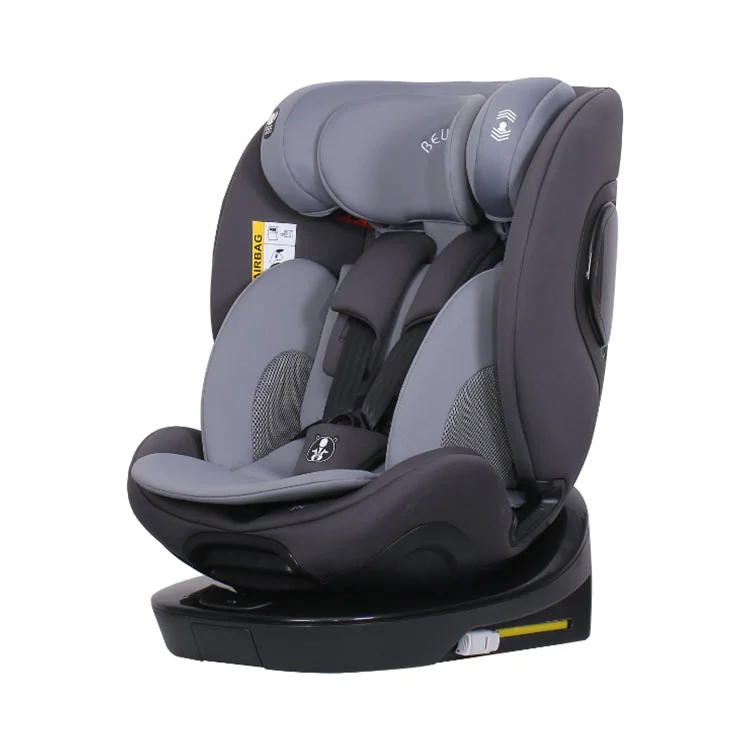
Our BW25 is built exactly this way: a blow-molded shell over an injection-molded structure. You get the crash-spreading body and the precise, rigid base in one seat. It's also why BW25 sits at the top of our 360 rotating range — the build costs more, and it earns it.
The molding method isn't a grade. It's a tool. The question is whether the maker used the right tool for each part.
05The part that hits your margins: tooling
If you're sourcing or building a private label, molding isn't just an engineering detail — it drives your cost, your minimum order, and your lead time. Here's the reality most suppliers won't spell out.
An injection mold is a large block of machined steel. It's expensive to cut and takes weeks to make. That upfront cost is why a custom injection-molded shell needs a bigger order to make sense, and why the tooling fee shows up as a separate line in a custom quote.
A blow mold is far cheaper to make for a large hollow shape. So if you want a custom shell profile without a huge tooling bill, blow molding often gets you there for less — and faster. If you want a premium, tightly-detailed finish and you plan to run high volume, injection tooling pays back over the run.
The takeaway for a buyer: ask which method a custom shell needs before you budget. It changes your MOQ, your setup cost, and your timeline. We walk customers through this on our customization page.
06How to inspect a sample shell
When a sample lands on your desk, the cover hides the shell — so ask for a bare shell too, and check these. They're the tells we look for on our own line.
- Sink marks: small dents or dips on an injection part mean uneven cooling or thin ribs underneath — a sign of a rushed process.
- Weld / knit lines: faint seams where two plastic flows met. On a load-bearing part, a visible weld line can be a weak point.
- Short shots: an injection part that didn't fill completely — thin edges, missing corners. Reject it.
- Wall evenness (blow): press and flex different areas of the shell. It should feel uniform, with no soft, oil-canning spots that pop in and out.
- Weight consistency: weigh several samples of the same part. Big swings mean the wall thickness isn't controlled batch to batch.
07Does the molding method affect safety?
Only through quality, not through the method itself. Both an injection and a blow-molded seat must pass the same crash and side-impact tests under ECE R129 (i-Size) before they can be sold. The method is an engineering choice about how to hit that bar — it is never a shortcut around it.
That's the honest frame for a buyer: don't ask "is blow molding safe?" Ask "does this seat carry the R129 label, and is the wall made well?" We cover the certification side in our i-Size guide, and you can see our own testing on the quality-control page.
08Bewell's molding map
Here's how the methods land across our range, so you can match a build to your price point. It also shows the pattern: rotating shells lean on blow molding, boosters lean on injection, and our flagship combines both.
| Model | Type | Molding |
|---|---|---|
| BW25 | 360 all-stage | Blow + injection |
| BW22 / BW23 | 360 all-stage | Blow |
| BW17 | Forward-facing harness | Blow |
| BW26 | Forward-facing harness | Injection |
| BW16 / BW15 | High-back booster | Injection |
| BW29AB | Backless booster | Blow |
Deciding what to stock? A booster range leans injection for its crisp structure; a rotating range leans blow for its light, energy-spreading shell. Tell us your target price and market and we'll match the method to it.
Common questions
Are blow-molded car seats safe?
Yes, when the shell is made well and the seat passes R129 crash testing. A blow-molded shell's hollow double wall is designed to absorb and spread crash energy. Safety comes from wall quality and certification, not from avoiding blow molding.
Is injection or blow molding better for a car seat?
Neither is better overall. Injection is best for precise, structural parts; blow molding is best for large one-piece shells. Many good seats use both — injection for the base and guides, blow molding for the outer shell.
What are car seat shells made of?
Usually a high-strength plastic such as polypropylene, chosen for its mix of strength, flex, and low weight. The same family of plastic can be used in both molding methods.
Can I tell how a car seat was made just by looking?
Not once the fabric is on. Ask the factory which method each major part uses, and request a bare shell to inspect wall thickness and finish.
Does the molding method change the price?
Yes. Injection tooling costs more upfront, so custom injection shells need higher volume to pay off. Blow tooling is cheaper for large shells, which can lower the cost of a custom body.
Sources
- UNECE — Regulation No. 129 (i-Size): crash and side-impact test requirements
- NHTSA — Car Seats and Booster Seats: choosing and inspecting a seat
- Bewell 2026 Product Catalogue — molding method by model (BW25, BW22, BW23, BW26, BW17, BW16, BW15, BW29AB)
General guidance only. Always follow the seat's manual and your vehicle owner's manual, and check the approval label before installing、