

We're a car seat factory, so treat this as a guide written by the other side of the table. Everything below is what we'd want a buyer to ask us — including the questions that would expose a weak supplier.
Sourcing car seats is not like sourcing phone cases. A car seat is a regulated safety product — if the certificate is wrong, your shipment can be held at customs, pulled from shelves, or recalled at your expense. The supplier choice isn't just about price. It's about whether you can legally sell what arrives.
The good news: the checks that separate a real manufacturer from a reseller are simple, and you can do most of them by email before anyone visits a factory. Here's the order we'd run them in.
01Step 1: Confirm it's a factory, not a trader
Plenty of "manufacturers" on B2B platforms are trading companies. That isn't automatically bad — but you pay a margin, you lose direct control over quality, and when something goes wrong, the person you're emailing can't walk to the line and fix it.
Ways to tell, in order of how hard they are to fake:
- Ask for a live video call from the molding shop, not a recorded tour. Ask them to walk from raw plastic to a finished shell. A trader can't.
- Ask which parts they mold themselves and which they buy. A real factory answers instantly and specifically — "we blow-mold the shell and injection-mold the base."
- Check the certificate holder's name against the company you're talking to. Traders often show a certificate belonging to someone else's factory.
- Ask about their mold shop. Factories that build their own molds can change a design. Traders send your drawing somewhere else and wait.
The fastest tell is a technical question with no marketing answer. Ask: "Which of your models are blow-molded and which are injection-molded, and why?"
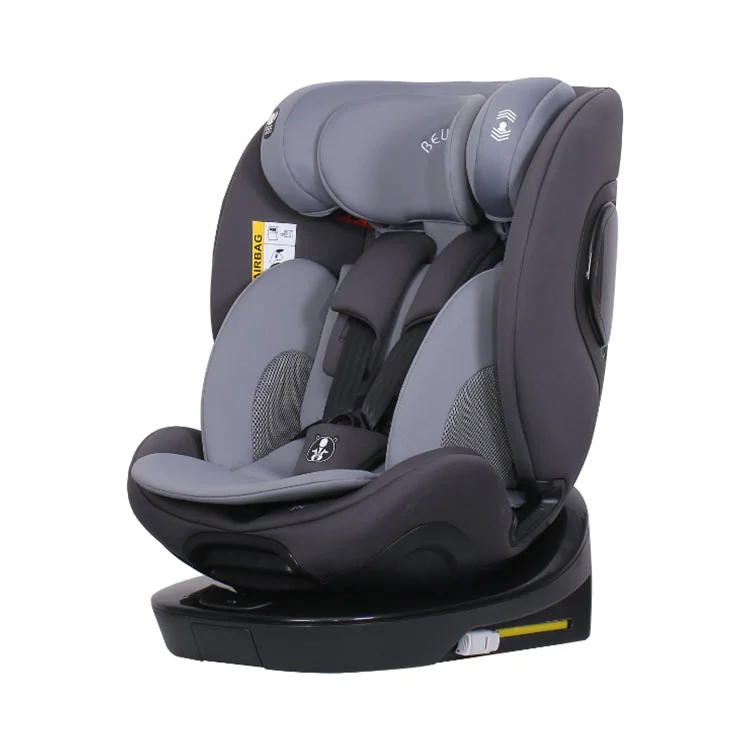
Anyone who runs the lines answers in one breath — we'd say our rotating shells are blow-molded to absorb and spread crash energy, our boosters are injection-molded for a precise structure, and our flagship BW25 uses both in one seat. A reseller gives you an adjective. If you want the background, see our molding explainer.
02Step 2: Verify the certificates properly
This is where most bad orders begin. A certificate photo in a PDF proves very little. What matters is which standard, whose name, and whether it's still live.
| Market | Standard | What to verify |
|---|---|---|
| Europe / UK | ECE R129 (i-Size) | Approval number, height range, issuing authority, holder's name |
| China domestic | CCC / 3C | Certificate number and validity |
| United States | FMVSS 213 | Different standard entirely — an ECE seat is not automatically US-legal |
Three checks that take five minutes each:
- Match the approval number on the certificate to the orange label on the physical sample. They must agree.
- Confirm the standard version. R129 replaced R44 for new seats in Europe — a seat certified only to the old R44 can no longer be sold new there. Our R129 vs R44 guide covers the timeline.
- Ask who tested it. A recognized third-party lab and a named issuing authority, not "our internal test."
03Step 3: Check real production capability
A valid certificate proves one seat passed one test. Consistent quality across 5,000 seats is a different question — and it's the one that decides whether you get returns.
Ask what happens after approval:
- Do they run COP (Conformity of Production) tests? COP is ongoing testing that proves production still matches the approved sample. A factory that only has the original approval is showing you a photo of its best day.
- Do they crash-test their own production, and how often? We crash-test 1 in every 5,000 seats we build, on top of third-party approval testing.
- Do they use virgin material? Recycled plastic in a safety shell is a real risk. We use 100% virgin material — ask your supplier to state theirs in writing.
- What's inspected before shipping? Ask for the specific checklist: dimensions, load-bearing, function, and finish, on which sample rate.
A certificate says "this seat passed once." COP testing says "this seat still passes." Only one of those protects your shipment.
You can see how we handle this on our quality control page and our factory page.
04Step 4: Get MOQ, lead time and terms in writing
Vague commercial terms are a warning sign in themselves. Before you send a deposit, you should have all of this on paper. Here are real numbers from our own operation so you know what normal looks like:
| Item | What to expect |
|---|---|
| MOQ | Around 500 units, varying by project type and how much is customized |
| Prototype / sample | Roughly 10–15 days for a prototype cycle |
| Mass production | About 30–40 working days after deposit and confirmed details |
| Payment | Commonly T/T 40% deposit, 60% balance against copy of B/L |
| Incoterms | EXW, FOB or CIF — confirm which before comparing prices |
| Packing | Neutral cartons by default; custom color boxes and multi-language manuals on request |
Two quotes are only comparable if the Incoterm matches. An EXW price looks cheaper than FOB because it excludes getting the goods to the port. Always ask for the same term from every supplier.
And ask how many units fit a container — it changes your landed cost per seat more than most buyers expect. A big high-back seat and a compact backless booster can differ by several times over in units per 40HQ. We break that down in our booster comparison.
05Step 5: Test their OEM/ODM depth
If you're building a brand, "we do OEM" means nothing on its own. Ask what they can actually change, and at what cost. There's a big difference between a factory that will stitch your logo on and one that can modify structure.
A capable supplier should walk you through a defined path: inquiry and your idea or drawings → graphic design for your confirmation → prototype from the drawings → mold making → test sample sent for approval → mass production. That's the sequence we run, and if a supplier can't describe theirs, they probably outsource it.
Ask what's customizable at your volume. In practice this ranges from fabric color, logo embroidery, and labels, through packaging, PE bags and local-language manuals, up to added features and structural changes for specific vehicle models. Real orders look like this: one of ours shipped 1,300 units with custom logo embroidery and beige and pink fabric covers; another added a magnetic design, extra webbing, custom label embroidery, and Japanese-language manuals.
Deep customization usually needs new tooling, which is the real cost driver — see our note on tooling economics before you budget. Our full process is on the customization page.
06Red flags that should end the conversation
- A certificate in someone else's company name that they can't explain.
- Only R44 certification offered for the European market — that standard is closed for new sales.
- A price far below everyone else. In a safety product, that gap usually comes out of material grade or wall thickness.
- No COP testing, or confusion about what COP means.
- Won't do a live video call from the production line.
- Vague on MOQ, lead time, or Incoterms after repeated asking.
- A backless booster offered for children under 125 cm — R129 doesn't approve that, so the paperwork is wrong somewhere.
07The email you should send every supplier
Copy this. The answers — and how fast they come back — will sort your shortlist quickly.
- Are you the manufacturer? Which parts do you mold in-house?
- Can we do a live video call from your molding and assembly lines?
- Which standard is each model certified to, and in whose name is the certificate?
- Can you send the certificate plus a photo of the approval label on the product?
- Do you run COP tests? How often do you crash-test production units?
- Do you use virgin material?
- What is your MOQ for our configuration?
- Prototype lead time and mass production lead time?
- Payment terms and Incoterm?
- How many units per 40HQ for this model?
- What can be customized at our volume, and what needs new tooling?
Where to start
If you're early in sourcing, work out your product mix first — which stages and seat types your market needs — then screen suppliers against it. Our guide to car seat types maps the range, and the support leg vs top tether guide covers a fitment issue that affects which models sell in your market.
When you're ready to compare a real quote, send us your requirements — model, market, volume, and any customization — and we'll answer every question on the list above. You can also browse the full product range first.
Common questions
How do I know if a Chinese car seat supplier is a real factory?
Ask for a live video call from the molding line, ask which parts they mold in-house, and check that the safety certificate is issued in their own company name. Traders struggle with all three.
What certification do baby car seats need?
For Europe and most i-Size markets, ECE R129. For China, CCC (3C). For the United States, FMVSS 213. One certificate does not cover all markets, so confirm the standard for your destination before ordering.
What is a typical MOQ for OEM baby car seats?
Around 500 units is common, though it varies with project type and how much customization is involved. Deep changes that need new tooling usually require higher volume to be viable.
How long does a car seat order take?
Expect roughly 10–15 days for a prototype, then about 30–40 working days for mass production after the deposit and all details are confirmed. Volume and complexity move both numbers.
What payment terms are normal when importing car seats from China?
T/T with 40% deposit and 60% balance against a copy of the bill of lading is common. Always confirm the Incoterm — EXW, FOB or CIF — so you're comparing quotes on the same basis.
Sources
- UNECE — Regulation No. 129 (i-Size): approval and Conformity of Production requirements
- NHTSA — Car Seats and Booster Seats: US standards context (FMVSS 213)
- Bewell company pages — manufacturing, quality control, customization process and order terms
Commercial terms shown are typical ranges and vary by project, volume and specification. Confirm all terms in writing with your supplier.