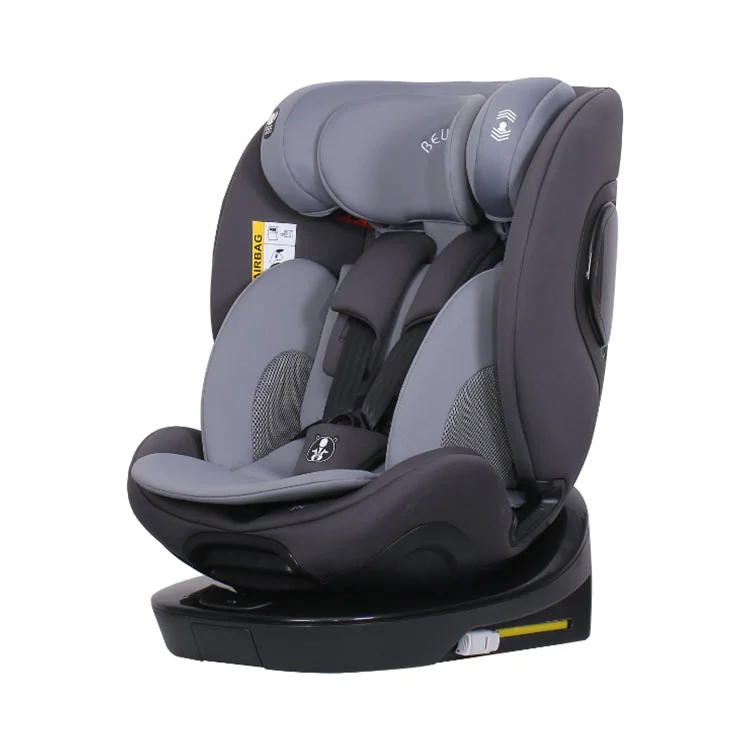
We build car seats, which means we also write the feature lists. So we can tell you something a review site cannot: which of those bullet points describe structure, and which exist because they sound good on a box.
Quick Answer Four features do the real protective work: side-impact protection, a five-point harness, energy-absorbing foam in the shell, and a proper third anchor (support leg or top tether) on an ISOFIX seat. Several more are genuinely useful because they prevent mistakes — install indicators, a no-rethread harness, rotation. And a handful are comfort or convenience sold as safety, with memory foam the most common example. If a feature has no effect on how force travels through the seat, it is not a safety feature.
Here is the test we use internally, and you can use it too. In a crash, energy has to go somewhere. A real safety feature changes where that energy goes — it absorbs it, spreads it, or redirects it away from the child. Anything that does not touch that question is comfort, convenience, or decoration.
Those other things can still be worth paying for. A seat that is comfortable gets used. A seat that is easy to install gets installed correctly. But it helps to know which is which before you pay for it.
Why trust this guide: Bewell has manufactured child car seats in Ningbo since 2015. We mold the shells, specify the foam, source the webbing and buckles, and test to ECE R129 including side impact. The verdicts below come from deciding, model by model, what actually goes into a seat and what it costs.
Every common feature, scored on one question: does it change how crash energy reaches the child?
Car seat features and what each one actually does
Feature
Verdict
What it really does
Side-impact protection
Real
Foam-filled wings sit between the head and the door. Required to be tested under R129.
Five-point harness
Real
Spreads force across shoulders, hips and between the legs — the strongest points on a small body.
Energy-absorbing foam (EPS/EPP)
Real
Rigid foam crushes to absorb impact. Hidden inside the shell — you cannot feel it.
Support leg or top tether
Real
The third anchor that stops an ISOFIX seat pitching forward in a crash.
ISOFIX connectors
Real
Rigid anchoring that clicks, so a correct install is verifiable rather than hopeful.
Install indicator or alarm
Real
Turns "I think it's tight" into a green light. Misuse is a leading cause of poor protection.
Steel-reinforced frame
Depends
Valuable where load concentrates — a rotating base, for example. Meaningless as a phrase without knowing where the steel is.
360° rotation
Depends
Not protective in itself. Safety benefit is indirect: it makes rear-facing easy, so families keep it longer.
No-rethread harness / adjustable headrest
Depends
Not structural, but it keeps harness height correct as the child grows. Correct height is structural.
Anti-rebound bar
Depends
Limits rearward rebound movement on rear-facing seats. Useful where fitted; not every design needs one.
Memory foam padding
Comfort
Soft foam you can feel. It is not the foam that protects. Pleasant, not protective.
Breathable or cooling fabric
Comfort
Real benefit for hot climates and long trips. No effect on crash performance.
Extra newborn inserts and pads
Depends
Fine if supplied with the seat and used per the manual. Aftermarket padding is not tested with the seat.
Cup holders, canopies, storage
Convenience
Zero safety function. Worth having if you want them; not worth paying a safety premium for.
The four that carry the load
Side-impact protection
Side crashes are the most dangerous type for a child, because there is very little vehicle between the child and the impact. Deep side wings filled with energy-absorbing foam sit between the head and the door and take the hit first.
This is also a good example of regulation doing its job. The older ECE R44 standard never required a side-impact test at all. ECE R129 makes it mandatory. So "has side impact protection" means something specific now — it means the seat was tested that way. Our R129 guide covers what else the standard requires.
The five-point harness
Five contact points: two shoulders, two hips, one between the legs. That geometry spreads crash force onto the skeleton instead of the abdomen, and it stops the child sliding down under the belt.
Under R129, children up to 105 cm must be held by an internal harness or an impact shield rather than the adult belt. Above that height, a booster positions the vehicle belt instead — see high-back vs backless.
Energy-absorbing foam
This is the one shoppers most often get wrong, because the foam that protects is invisible and the foam that does not is the first thing you touch.
From the factory floor — two completely different foams
A seat contains at least two foams with unrelated jobs. The soft layer under the fabric is comfort foam. It changes how the seat feels. It does nothing in a crash.
The one that matters is rigid EPS or EPP built into the shell and head wings. EPS crushes once to absorb an impact, like a bicycle helmet. EPP can take repeated compression and springs back. Neither is soft, and neither is something a customer will ever notice in a showroom.
Which is exactly why "memory foam" ends up on the box and "EPP in the head wings" does not. One is easy to sell. The other is what you are actually buying.
The third anchor
Two lower ISOFIX points alone let a seat rotate forward in a crash, pivoting on those points. A support leg braced to the floor, or a top tether strapped to an anchor, stops that rotation. Under R129, one of the two is required. Which one suits you depends on your car, not on which sounds stronger — we explain that in support leg vs top tether.
The quiet category: features that stop mistakes
There is a middle group that deserves more credit than it gets. These features do not absorb energy. They stop a parent from getting the install wrong — and a correctly installed average seat protects better than a badly installed excellent one.
Install indicators and alarms. A green light for a locked connector, a properly loaded support leg, or a tightened tether. This removes guesswork.
Green belt guides and a single belt path. R129 requires belt-routed seats to mark the correct path in green, and to have only one path per install method. Older seats had multiple paths, and people used the wrong one.
No-rethread harness. The harness height moves with the headrest, so it stays correct as the child grows instead of drifting wrong between adjustments.
The regulation itself now treats mistake-prevention as a safety requirement. That tells you how much of real-world protection comes down to installation.
What is mostly marketing
To be clear: none of these are bad. They are just not safety.
Memory foam. Comfort. Nice to have. Not protection.
Breathable and cooling fabric. Genuinely useful in hot markets, and one of the first things buyers in the Middle East ask about. Still not crash performance.
Cup holders, canopies, storage pockets. Convenience. Buy them if you want them.
Premium-sounding materials with no location. "Reinforced," "aviation-grade," "high-strength" mean nothing without a part attached. Reinforced where?
One that is a genuine risk: aftermarket padding, strap covers, and inserts bought separately. They were not tested with the seat, and they can change how the harness sits. Use only what came in the box, or what the manufacturer sells for that model.
How to read a vague claim
Feature lists are written to be flattering. Three habits cut through most of it.
When you see
Ask
"Steel reinforced"
Reinforced where? A steel frame under a rotating base is meaningful. A steel bracket somewhere is not.
"Side impact protection"
Is the seat certified to R129, which tests it? Or is it a shape with no test behind it?
"Memory foam comfort"
Fine — but what energy-absorbing foam is in the shell?
"Meets safety standards"
Which standard, which approval number, and does it match the orange label on the seat?
"Suitable from 4 years, backless"
A warning sign. R129 approves backless boosters only from 125 cm.
The last line in that table is worth repeating, because it is a fast way to spot a seat whose paperwork does not add up. Rules by market are covered in our certification by country guide.
What to do with all this
For a parent: get the four real features, insist on the current standard for your country, and then spend whatever is left on comfort and convenience — because those are the things that make a seat pleasant to live with for a decade. There is no shame in buying the comfortable one, as long as the structure underneath is right.
For a buyer or distributor, the same logic runs backwards. Comfort features sell the seat on a shelf. Structural features decide whether you have a returns problem or a recall. Specify the structure first, then let the marketing bullets do their job.
What are the most important car seat safety features?
Side-impact protection, a five-point harness, energy-absorbing foam in the shell, and a proper third anchor such as a support leg or top tether on an ISOFIX seat. Install indicators matter too, because they prevent fitting mistakes.
Is memory foam a safety feature in a car seat?
No. Memory foam is comfort padding. Crash protection comes from rigid energy-absorbing foam such as EPS or EPP built into the shell and head wings, which you cannot feel through the cover.
Does a car seat need a steel frame?
It depends where the steel is. A built-in steel frame under a rotating base is meaningful because that is where load concentrates. "Steel reinforced" as a general claim, with no part named, tells you nothing.
Is a 360 rotating car seat safer?
Not directly. The rotation helps loading, and in the travel position the seat is locked like any other. Its safety benefit is indirect: easier loading means families keep children rear-facing longer, which is safer.
Are extra cushions and strap covers safe to use?
Only the ones supplied with the seat or sold by the manufacturer for that model. Aftermarket padding was not tested with the seat and can change how the harness sits on the child.
How do I know side-impact protection is real?
Check that the seat is certified to ECE R129, which makes side-impact testing mandatory. The older R44 standard did not require it, so wings on an R44 seat were never tested that way.
About Bewell
Ningbo Bewell Baby Products Manufacturing Co., Ltd. has manufactured child safety seats since 2015. Our Ningbo factory runs in-house mold making, blow and injection molding, sewing, assembly and inspection, with an annual capacity of 200,000+ seats. Every model is certified to ECE R129 (i-Size) including side-impact testing; we hold China 3C certification and ISO 9001, use 100% virgin material, and run structural, impact, material, service-life and fabric testing alongside regular COP checks.
Sources
UNECE — Regulation No. 129 (i-Size): mandatory side-impact testing, harness requirement to 105 cm, backless booster approval from 125 cm
We use cookies to offer you a better browsing experience, analyze site traffic and personalize content. By using this site, you agree to our use of cookies.
Privacy Policy