

"What car seat should my child be in right now?" Every parent asks it — and then asks it again a year later, because the answer keeps changing as your child grows.
Here's the thing most parents get wrong: the stages aren't really about age. They're about size. Age is just a rough guide. Your child moves to the next stage when they outgrow the height or weight limit of their current seat — not on a birthday.
This guide walks through all four stages, what to look for at each, and — most importantly — the signs your child is ready to move up. Bookmark it; you'll be back.
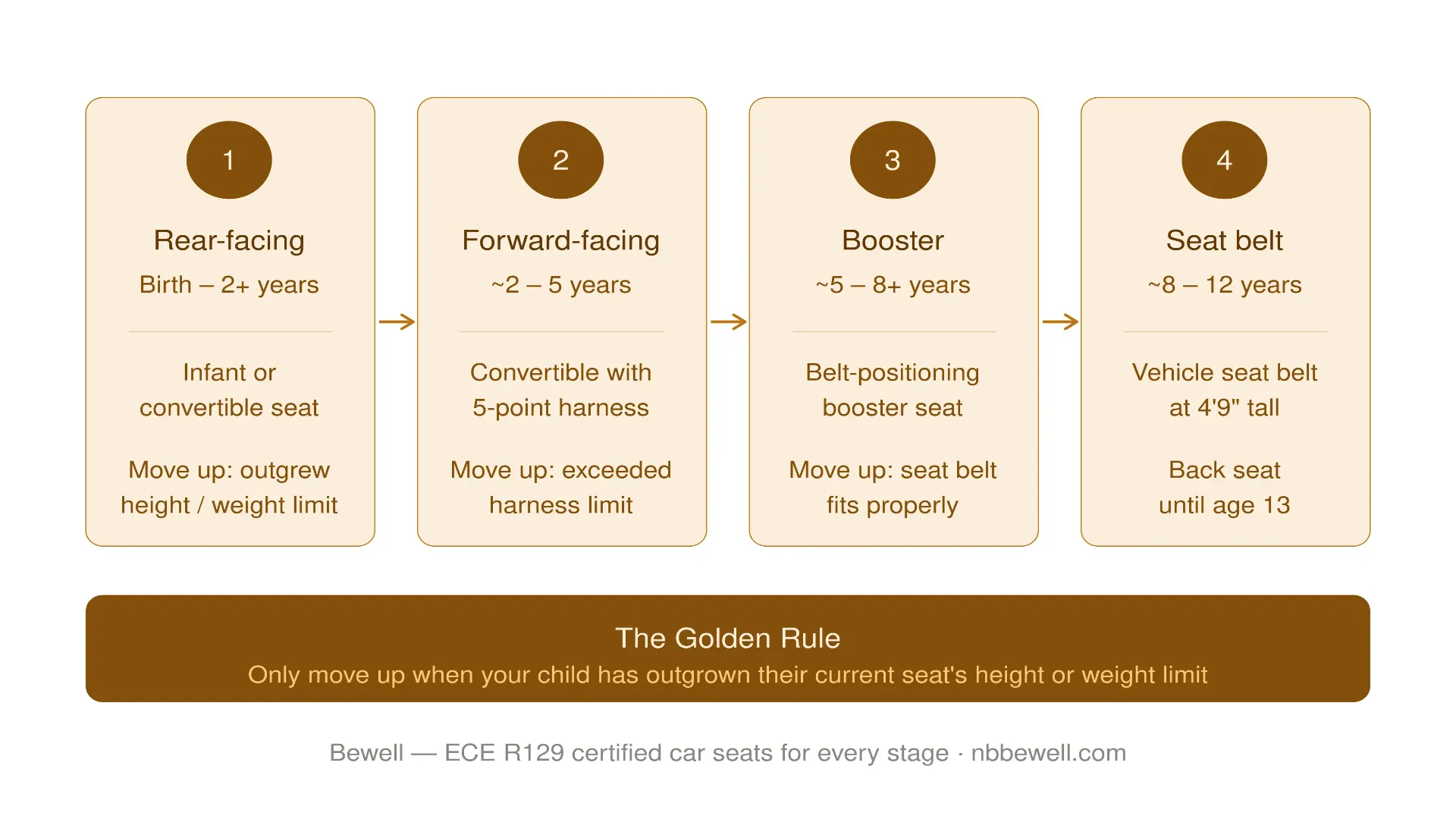
The 4 Car Seat Stages at a Glance
The whole journey on one chart. Remember: these ages are approximate — go by your child's height and weight, and your seat's limits.
| Stage | Typical Age | Seat Type | Move up when... |
|---|---|---|---|
| 1. Rear-facing | Birth – 2+ years | Infant, convertible, or all-in-one (rear mode) | Child hits the seat's rear-facing height/weight limit |
| 2. Forward-facing | ~2 – 5 years (AAP: to age 4+) | Convertible or all-in-one with harness | Child exceeds the harness height/weight limit |
| 3. Booster | ~5 – 8+ years | Belt-positioning booster | Seat belt fits properly without the booster |
| 4. Seat belt | ~8 – 12 years (4'9" tall) | Vehicle seat belt, back seat | N/A — but stay in the back seat until 13 |
Notice how the stages overlap. That's deliberate — an all-in-one car seat can cover stages 1 through 3 in a single seat, which is why many parents choose one to avoid buying three separate seats. More on that at the end.
Rear-Facing (Birth to 2+ Years)
Every child starts here, and this is the stage that matters most for safety. Your child rides facing the back of the car, so that in a frontal crash — the most common severe type — the shell cradles their head, neck, and back all at once.
How long?
As long as possible. NHTSA says every child under age 1 must ride rear-facing, and the AAP recommends staying rear-facing until your child outgrows the seat's height or weight limit — which for most kids is age 2, and often 3 or 4. This is a change from the old "turn at age 1" advice.
Seat types for this stage
- Infant car seat — rear-facing only, carrier-style, typically rated 22–35 lbs. Outgrown fastest.
- Convertible car seat — rear-faces to a higher limit (often 40–50 lbs), then turns forward. Lasts longer.
- All-in-one — rear-faces, then forward, then boosts. One seat, the whole journey.
Why rear-facing is so much safer is worth understanding — our guide on rear-facing vs forward-facing and our crash-protection science explainer both break it down.
Forward-Facing With a Harness (~Age 2–5)
Once your child genuinely outgrows rear-facing, they move to a forward-facing seat with a five-point harness and a top tether. The harness still restrains them at five points; the tether limits how far their head moves forward in a crash.
How long?
The AAP recommends a forward-facing harnessed seat until at least age 4 — and ideally until your child hits the harness's top height or weight limit. Many seats harness to 60–65 lbs, so plenty of kids stay harnessed to age 6 or 7.
Don't rush this transition. A harness restrains better than a booster's seat belt for younger kids. Our guide on the top tether strap explains why that connection matters so much at this stage.
Booster Seat (~Age 5–8+)
A booster doesn't have its own harness. Its job is simpler but crucial: it raises your child up so the vehicle's lap-and-shoulder belt sits correctly — low across the hips, flat across the center of the shoulder and chest.
Why it matters: an adult seat belt on a too-small child rides up onto the soft belly and across the neck, which can cause serious injury in a crash. The booster fixes the geometry.
How long?
Until the seat belt fits properly without the booster. For most kids that's around 4'9" (57 inches) tall, usually between ages 8 and 12. Booster use reduces serious injury risk for 4–8 year olds by about 45% compared to a seat belt alone.
Knowing exactly when to switch into — and out of — a booster trips up a lot of parents. We made a whole guide on when to switch to a booster seat with a simple 5-step fit test.
Seat Belt Alone (~Age 8–12)
The final stage. Your child is big enough that the vehicle's seat belt fits correctly on its own. But "big enough" has a specific test — don't go by age alone.
The seat belt fit test
Your child is ready for the seat belt alone when, sitting all the way back against the vehicle seat:
- Their knees bend naturally at the edge of the seat, and feet rest flat on the floor.
- The lap belt sits low and snug across the upper thighs — not the belly.
- The shoulder belt crosses the center of the shoulder and chest — not the neck or face.
- They can sit like this comfortably for the entire ride, without slouching.
Most kids pass this around 4'9" tall, between ages 10 and 12. If any part fails, they still need a booster — even if they protest.
One more rule: keep your child in the back seat until age 13, regardless of size. The back seat is meaningfully safer for kids.
One Seat for the Whole Journey?
Four stages can mean buying three or four seats over 12 years. That's why all-in-one seats exist — they cover rear-facing, forward-facing, and booster modes in a single shell, adjusting as your child grows.
Our BW23 all-in-one is built for exactly this: rear-facing from 40 cm (newborn) to 105 cm, then forward-facing up to 150 cm — roughly birth through age 12. It has a 360° rotating base, ISOFIX with a top tether, and is certified to ECE R129 (i-Size). The BW22 and BW25 cover the same span with a support-leg install.
An all-in-one isn't the only right answer — some parents prefer an infant carrier for the newborn months, then switch. But if you want to buy once and follow every stage correctly without a mid-journey purchase, it's hard to beat.
Still deciding between seat types? Our comparisons of infant vs convertible car seats and the best convertible car seats go deeper.
FAQs
What car seat should my child be in by age?
Rough map: rear-facing from birth to at least age 2, forward-facing with a harness from around 2 to 5, a booster from around 5 to 8+, and the seat belt alone somewhere between 8 and 12. But age is the guide, not the trigger. What actually decides when to move up is whether your child has hit the height or weight limit printed on your seat.
When should my child turn forward-facing?
When they outgrow the rear-facing limit — not on a birthday. The AAP says keep them rear-facing until at least age 2, and longer if your seat allows. A lot of kids stay rear-facing to age 3 or 4 with a good convertible.
What age does a child stop using a car seat entirely?
When the vehicle seat belt fits them properly on its own. That's usually around 4'9" tall, somewhere between ages 10 and 12. And even then, back seat until 13.
Can my child skip the booster stage?
No, and here's why. An adult seat belt on a too-small kid rides up onto the belly and across the neck. In a crash, that's exactly where you don't want it. The booster's whole job is to reposition the belt down to the hips and across the shoulder. Skip it, and the belt itself becomes the injury.
Is age or weight more important for car seat stages?
Size wins every time. Age is a rough guide — a chart to check yourself against — but the real trigger to move up is hitting the height or weight limit on your specific seat. Two four-year-olds can be in different stages depending on how big they are.
Can one car seat cover all the stages?
Yes — that's what an all-in-one is for. Rear-facing, forward-facing, and booster modes in the same shell, typically birth to age 12. It skips the mid-journey seat purchases. Some parents still start with an infant carrier for the newborn stroller months, then switch — that works too.
The Bottom Line
Four stages, one simple principle: keep your child in each stage until they've truly outgrown it, then move up — never the other way around. Rear-facing as long as possible, harness as long as possible, booster until the belt fits, back seat until 13.
Go by height and weight, not birthdays. Check the limits on your seat. And when in doubt, keep them where they are a little longer — the safer stage is always the one they're in now.
Browse our full range of ECE R129 certified car seats, including all-in-one models that follow your child through every stage. Every seat is produced in an ISO 9001 certified factory with test reports on our quality control page.
About Bewell
This article is for informational purposes and summarizes AAP and NHTSA guidance. Car seat laws vary by state — always check your local requirements and your seat's manual.
Sources:
- National Highway Traffic Safety Administration (NHTSA) — Car Seat Recommendations for Children by Age & Size
- American Academy of Pediatrics — "Child Passenger Safety" policy statement (Durbin & Hoffman, Pediatrics, 2018; reaffirmed 2025)
- Centers for Disease Control and Prevention (CDC) — Child Passenger Safety
- Governors Highway Safety Association (GHSA) — Child Passenger Safety
- Bewell 2026 Product Catalogue — model specifications