

Two car seats. Two prices. Two completely different products that both go in the back of your car. Which one do you actually need?
This is one of the first big purchasing decisions every new parent makes — and the marketing makes it harder, not easier. Infant seat brands tell you their carrier is essential. Convertible seat brands tell you a one-seat solution saves you money. Both are partly right.
Here's the honest comparison, including which one's actually safer (spoiler: it's not what most parents think).
The 30-Second Comparison
If you read nothing else:
| Infant Car Seat | Convertible Car Seat | |
|---|---|---|
| Direction | Rear-facing only | Rear-facing, then forward |
| Carrier? | Yes — clicks out | No — stays installed |
| Typical age range | Birth to ~12 months | Birth to 4 years (or 12, for all-in-one) |
| Lasts how long? | 1–2 years before outgrown | 4+ years (or whole childhood) |
| Stroller compatible? | Yes (travel system) | No |
| Rear-facing limit | Lower (typically ~30 lbs) | Higher (often to ~105 cm / 40+ lbs) |
| Number of seats you'll buy | 2–3 over time | 1–2 over time |
So which is right for you? That depends on three things: how you'll use it, how long you want it to last, and whether "clicks into the stroller" is worth the trade-off. Let's break them down.
What Is an Infant Car Seat?
An infant car seat is a small, rear-facing-only carrier with a handle. It clicks into a base that stays installed in your car, and clicks out to become a carrier — useful for sleeping newborns you don't want to wake. Most are also compatible with stroller frames to form a "travel system."
- Click-in / click-out convenience. Newborn asleep in the seat? Lift it straight out, snap it into a stroller, walk inside. No transferring a sleeping baby.
- Smaller, lighter to handle. Around 7–11 lbs empty. Easier to maneuver in tight back seats.
- Cozy fit for newborns. Designed specifically for small babies, with deeper inserts and a tighter recline.
- Short lifespan. Most babies outgrow them by 12 months — by height long before weight. Then you have to buy another seat.
- Lower rear-facing limit. Typically maxes out around 30–35 lbs and 32 inches. Limits how long you can stay in the safest position.
- Easy to misuse as a sleeper. The carrier design makes it tempting to leave baby in the seat for naps at home — which the AAP advises against.
For more on why naps in car seats are risky, see our guide to how long babies can be in a car seat.
What Is a Convertible Car Seat?
A convertible car seat stays installed in your vehicle and "converts" — meaning the same seat works rear-facing for the infant and toddler years, then turns forward-facing once your child outgrows the rear-facing limits. Some go further and become an "all-in-one" by also functioning as a booster, covering ages 0 to 12.
- Higher rear-facing limit. NHTSA explicitly notes that convertible and all-in-one seats "typically have higher height and weight limits for the rear-facing position, allowing you to keep your child rear-facing for a longer period of time." This is the single biggest safety advantage.
- Lasts much longer. A convertible covers infant through toddler; an all-in-one covers infant through age 12. One purchase, not three.
- More cost-effective long-term. Skip the buy-a-new-seat-every-2-years cycle.
- Stays installed correctly. Because you're not clicking it in and out, the install holds — which matters because installation error is the #1 cause of car seat ineffectiveness.
- No carrier function. You'll transfer a sleeping baby into your arms or a stroller, not just lift them out attached to a seat.
- Bulkier in the car. Convertibles are larger and heavier than infant carriers — usually 7.5–13 kg.
- Need to fit a newborn well. Not all convertibles are sized for newborns. Look for ones that start at 40 cm height (the minimum spec for i-Size newborn use).
Are They Both Safe?
Short answer: yes.
Every car seat sold in the United States — infant or convertible — must meet the same federal standard, FMVSS 213, set by NHTSA. The same is true in Europe under ECE R129 (i-Size) or R44/04. Neither category is "safer" in some inherent way.
But here's where it gets interesting. Safety in the real world isn't just about which seat passes a crash test — it's about which seat lets you do the thing that matters most for child safety: keep your child rear-facing as long as possible.
Because convertibles allow rear-facing to much higher height and weight limits, they let you follow the AAP's "as long as possible" recommendation for years longer than an infant-only seat. That's not a marketing claim — it's NHTSA's own position.
If you want the full reasoning on why rear-facing protection matters so much more than the seat category, see our guide on rear-facing vs forward-facing car seats.
So Which Should You Actually Buy?
Three scenarios. Pick the one that sounds like you.
If you're going to do a lot of stroller walks, transfers, and short trips with a sleeping newborn
An infant car seat with a travel-system stroller is genuinely useful. Newborns sleep in the car constantly, and being able to lift them straight into the stroller is a real quality-of-life win. Plan to switch to a convertible around 9–12 months — usually when baby outgrows by height first.
You'll likely own 2–3 seats by age 12: infant carrier → convertible (or all-in-one) → optionally booster.
If you mostly drive places (errands, daycare, family visits), not stroll
Skip the infant carrier. A convertible or all-in-one seat from day one is fine — and it's what we recommend. The seat stays in the car, your child stays in the safest rear-facing position longer, and you save the cost of an extra seat.
You'll own 1–2 seats total: convertible or all-in-one → optionally booster.
If you want to buy once and be done
Look at all-in-one convertibles that cover 0 to 12 years (in Europe, height range 40–150 cm). One seat, the entire journey. Higher upfront cost, but the math works out — and you never face the "is it time for a new seat?" decision until age 12.
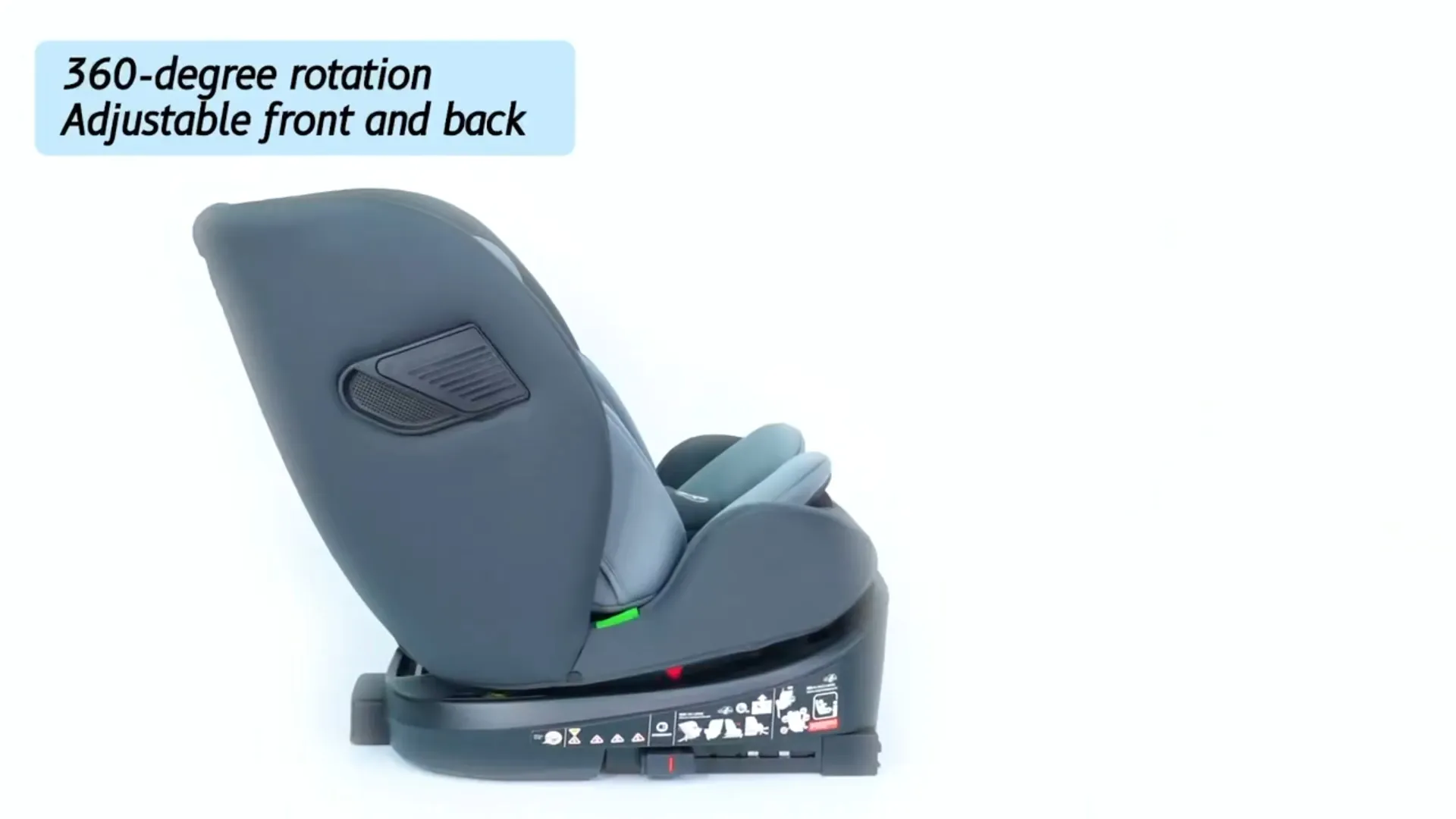
Our BW23 all-in-one car seat was built for exactly this — rear-facing from 40 cm (newborn) to 105 cm, then forward-facing to 150 cm, with a 360° rotating base and ISOFIX + top tether install. It's certified to ECE R129 (i-Size). For a lighter newborn-friendly option, the BW22 (7.5 kg) offers the same age range with a support-leg install instead.
4 Questions to Decide
Still on the fence? Ask yourself these:
- Will I do a lot of short stroller trips with a sleeping baby? Yes → infant seat is genuinely useful. No → convertible is fine.
- How long do I want this seat to last? ≤1 year → infant. 4+ years → convertible. To age 12 → all-in-one.
- How much do I want to spend total on car seats? Lower total → start with convertible or all-in-one and skip the infant seat. Spread cost → infant first, convertible later.
- Do I want my child rear-facing as long as possible? (Hint: the answer should be yes.) → convertible, because its rear-facing limit is higher.
FAQs
Is an infant car seat or convertible car seat safer?
Both are safe — they meet the same federal safety standard (FMVSS 213 in the US, ECE R129 in Europe). In practice, convertible car seats allow children to stay rear-facing longer, which is the single biggest safety factor. That makes a convertible the better long-term safety choice for most families.
Can I skip the infant car seat and go straight to a convertible?
Yes. Many parents do, especially if they aren't planning frequent stroller walks. Just make sure the convertible you choose is rated for newborn use — look for a minimum height of 40 cm (i-Size standard), proper newborn recline, and an insert if available.
When should I switch from an infant car seat to a convertible?
When your child reaches the infant seat's height or weight limit — usually by 12 months, and often by height first. NHTSA's specific rule: there should be at least 1 inch of clearance between the top of your child's head and the top of the seat shell. Less than 1 inch means time to switch.
Are convertible car seats good for newborns?
Yes, if they're designed for newborn use. Look for a starting height of 40 cm, a flat rear-facing recline, and ideally a newborn insert. The BW23, BW22, and BW25 all start at 40 cm and are designed for newborn through age 12.
Do convertible car seats have a carrier function?
No. Convertibles stay installed in the car. If you want carrier convenience, you need an infant car seat. But that trade-off comes with a shorter lifespan and a lower rear-facing limit.
How much can I save by buying a convertible instead of an infant seat?
It depends on price points, but typically you save the cost of one extra seat ($150–$400 in the US market) by going convertible from day one and avoiding the infant carrier purchase entirely. An all-in-one saves the cost of two extra seats by also replacing the booster.
The Bottom Line
Neither seat is universally better. The infant car seat wins on newborn convenience; the convertible wins on safety longevity and cost. Most parents who prioritize rear-facing time (which is what the safety data actually rewards) and don't need a click-in carrier come out ahead with a convertible from day one.
If you're somewhere in the middle, an all-in-one buys you the longest runway with a single seat — no transitions, no second purchase, and rear-facing capacity that lasts.
Browse our full range of convertible and all-in-one car seats, or see our deep-dive comparison of the best convertible car seats with extended rear-facing — every model is certified to ECE R129 (i-Size) and CCC, produced in an ISO 9001 certified factory.
Whatever you choose, keep them rear-facing as long as the seat allows. That's the decision that matters most.
About Bewell
This article is for informational purposes. Always consult each seat's manual for installation guidance specific to your vehicle and child.
Sources:
- National Highway Traffic Safety Administration (NHTSA) — Car Seats and Booster Seats recommendations (nhtsa.gov)
- American Academy of Pediatrics — "Child Passenger Safety" policy statement (Durbin & Hoffman, Pediatrics, 2018; reaffirmed 2025)
- FMVSS 213 — US federal safety standard for child restraint systems
- UNECE Regulation No. 129 (i-Size) — Enhanced Child Restraint Systems
- Bewell 2026 Product Catalogue — model specifications