As cars have become household essentials, child travel safety has emerged as a global priority. While traditional child safety seats are widely used, their lack of bottom stability often leads to tipping or sliding during collisions. This has led to the development of child seats equipped with support legs. Featuring innovative leg support designs, these seats enhance stability and significantly reduce risks.
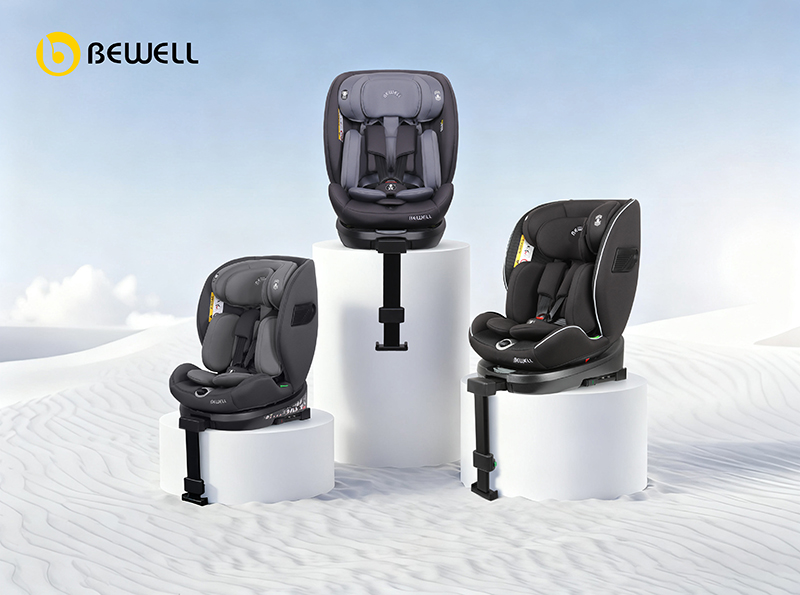
Firstly, what is a child safety seat with support legs? It is a car seat designed for children aged 0-12 (weight 0-36kg) that integrates an extendable leg support system. The core component is the “adaptive support leg,” typically made of high-strength aluminum alloy or carbon fiber, measuring 30-60cm in length. This leg support automatically adjusts its angle (0-20 degrees) to fit the vehicle’s interior space. During installation, the leg support extends under the car and forms a “three-point fixation” system with the ISOFIX interface, ensuring the seat is securely anchored like a “nail” in place.
The scientific design of child safety seat leg guards combines principles from mechanics and ergonomics. In car crashes, seat overturning often occurs due to bottom sliding: sudden braking causes inertial forces that tilt seats forward, leaving legs unsupported and potentially throwing children. The leg guards utilize a “triangular stabilization model” – combining vertical leg force, ISOFIX lateral force, and seatbelt diagonal force – to distribute impact energy, increasing friction by over 20%. This aligns with Newton’s third law: the leg support converts ground reaction force into seat stability, absorbing 25% of collision energy. From an ergonomic perspective, children’s flexible bones require a 90-degree natural leg bend to protect hip joints. The leg guards mimic a “hugging” posture to prevent legs from hanging and compressing blood vessels. Studies show that after use, children’s leg injury risk drops by 35% and spinal misalignment rate decreases by 18%.
When selecting a child safety seat, prioritize certifications like ECE R129 or i-Size, ensuring a wide leg adjustment range (at least 5 positions). During fitting, verify that the leg ends are less than 5cm from the vehicle floor without wobbling. When seated, the child’s legs should bend naturally with the seat belt snugly against the shoulders. Installation principle: “Backward first”— Use rear-facing models before age 2, as leg support helps prevent cervical spine injuries. Routine maintenance: Check leg support screws monthly and schedule annual professional inspections. Experts recommend applying the "5-second rule": If the seat moves less than 2cm when pulled after installation, it's compliant.
A support leg safety seat is an important way to protect children's safety when traveling. In addition, parents’ good driving habits are also an important way to protect children’s safety.
The support leg safety seat is not just a “seat”, but an “invisible armor” to protect children’s safety and future.