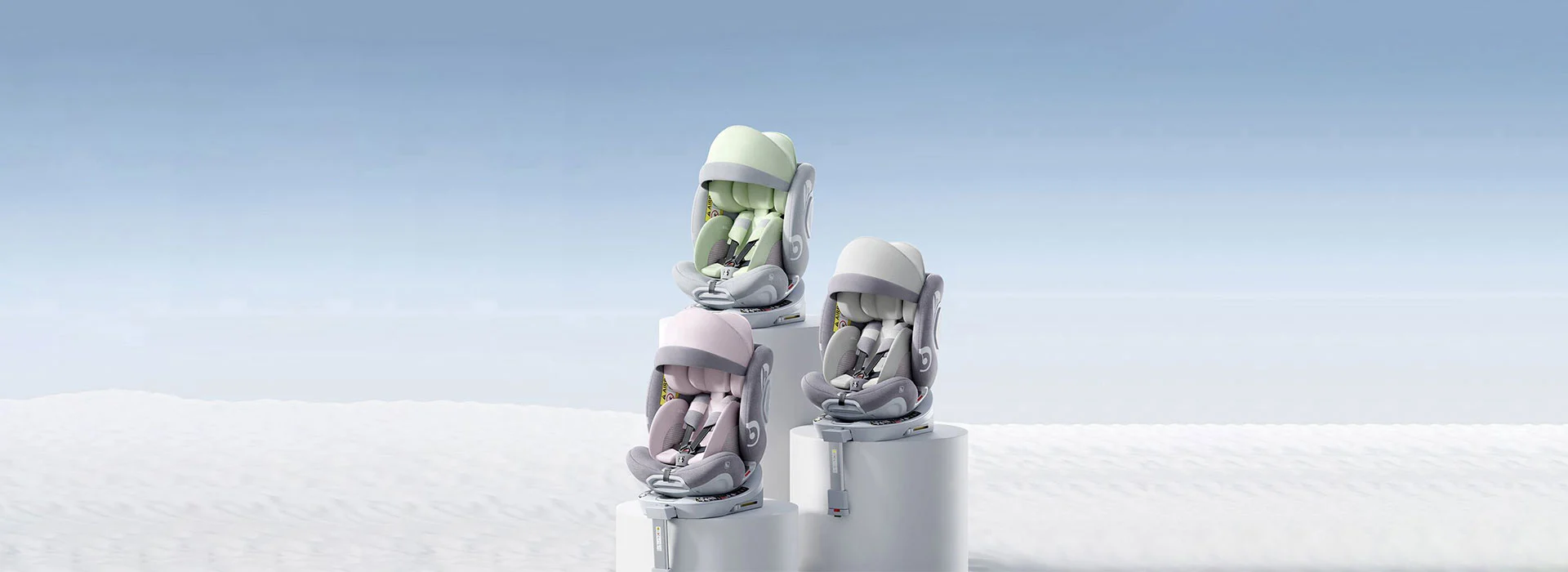
On parents’checklists for child safety seats, "recline angle" is often equated with "comfort." However, few realize that this design—seemingly about whether a baby can sleep soundly—is actually a core line of defense for protecting young lives. From anatomical characteristics to global regulatory requirements, from laboratory data to real accident cases, every degree of tilt embodies in-depth considerations for children’s safety. As a brand with over a decade of expertise in child travel safety, BEWELL combines research from its own biomechanics laboratory, experience with global authoritative certifications, and real accident reviews to uncover the underlying logic behind the "recline" design of child safety seats.
I. A Real Accident Warning: The Life-or-Death Gap Between 160°Recline and 100° Upright at 48km/h Collision
Last year, a distressing collision occurred on Germany’s A9 Autobahn: a moving Volkswagen was violently rear-ended by another vehicle, with a relative speed difference of 48km/h at the moment of impact. This speed is equivalent to a sudden crash at urban arterial road speed limits, classifying it as a typical moderate-to-severe traffic accident.
Fortunately, an 18-month-old toddler in the vehicle was seated in a rear-facing safety seat with a 160°large recline angle, which played a critical role during the collision. A professional accident reconstruction report afterward showed that the peak cervical spine force on the toddler was only 98N—far below the 600N safety limit specified in the EU R129 regulation. The child suffered only mild shock with no structural injuries.
However, a 3-year-old child in another accompanying vehicle was not as lucky. Using an upright forward-facing safety seat from a certain brand with a 100°angle, the peak cervical spine force soared to 2,100N during the collision—3.5 times the safety limit. This ultimately resulted in severe stretching injuries to the C4-C5 cervical segments, requiring long-term rehabilitation.
"With the same collision intensity and vehicle class, the difference in the children’s injury severity was night and day—the core variable was the safety seat’s recline angle," emphasized the engineer responsible for the accident inspection in the report. "An upright sitting position exposes children’s fragile cervical spines to direct shear forces from the collision, while a large recline angle effectively disperses impact forces, converting shear forces into compression forces that are more friendly to the body. This is the key to reducing the risk of cervical spine injuries." This real case reaffirms that the recline angle of a child safety seat is by no means a dispensable "comfort feature," but a "life-saving design" when facing collisions.
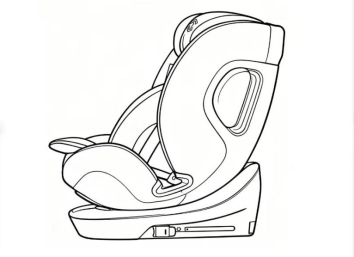
II. Anatomical Truth: Children’s Unique Head-Neck Structure Makes Upright Sitting an "Unprotected Risk"
Why is the recline angle so crucial for children? The answer lies in the distinct physical structure of young children compared to adults.
Through data collection and analysis of 200 children aged 0-12, the core differences are revealed:
Age
|
Head wt./body wt.
|
Cervical ossification
|
Ligament elasticity
|
Self-support
|
Newborn
|
13% (≈400 g)
|
2 vertebral arches open
|
Very low
|
Almost no self-support; the head flops easily.
|
1 yr
|
10% (≈800 g)
|
50% closed
|
Low Minimal
|
Limited support; easily loses control during a crash.
|
3 yr
|
8% (≈1.5 kg)
|
80% closed
|
Moderate
|
Basic self-support present, but poor impact resistance.
|
Adult
|
6% (≈4–5 kg)
|
Fully closed
|
High Full
|
Able to actively distribute impact forces.
|
III. Regulatory Origins: Why Do the World’s Three Major Standards Mandate Requirements for "Tilt Angle"?
The recline angle design of child safety seats is not an independent choice of brands, but a mandatory requirement of global authoritative safety regulations. From the EU R129 to the US FMVSS 213, and China’s GB 27887-2021, the three major mainstream standards have all established clear safety thresholds around "tilt angle," with the core goal of maximizing protection for children’s heads and necks.
EU R129 (i-Size): Explicitly Requires "≥110°Recline Angle" for Rear-Facing Installation
As one of the world’s most stringent child safety seat regulations, R129 (i-Size) clearly stipulates in Clause 7.3.2: For rear-facing installation, the angle between the seat backrest and the vertical plane (i.e., installation angle) shall not exceed 70°, which converts to a recline angle of not less than 110°. Behind this requirement lies a scientific conclusion based on numerous collision tests—within this angle range, the force distribution between the child’s head and torso is most balanced.
Additionally, R129 mandates that the neck Z-axis (flexion-extension direction) bending moment of the test dummy (representing children aged 0-4) must be≤40N·m. BEWELL’s laboratory data shows that when the seat recline angle reaches 160°, the dummy’s neck bending moment is only 28N·m—30% lower than the regulatory limit, providing a sufficient safety margin.
IV. Answers to Parents’Frequently Asked Questions: Scientific Responses to 3 Core Concerns About Large Tilt Design
Despite the scientific and data-proven safety value of large recline angles, parents still have many concerns in practical use. Combining laboratory test results and real user feedback, BEWELL addresses them one by one:
Q1: Will a larger recline angle cause the child to "slide out" of the seat?
A: No. BEWELL adopts a 5-point pre-tensioned safety belt design to fundamentally solve the problem of sliding. The 5-point safety belt is equipped with a pre-tensioner that automatically tightens during a collision, firmly securing the child in the seat.
Laboratory sliding tests show that at the maximum 160°recline angle, the pelvic displacement of a dummy simulating a 2-3-year-old child is only 4mm—far below the 20mm limit specified in EU R129 and China GB 27887-2021. Even for newborns using rear-facing installation, stable fixation can be achieved through precise adjustment of the safety belt, eliminating concerns about sliding.
Q2: Will a large-tilt seat occupy too much rear space, affecting other passengers?
A: Large-tilt seats with optimized designs can fully adapt to most family cars. Taking BEWELL’s BW25 model as an example, its base length is only 52cm, combined with a retractable ISOFIX guide slot that flexibly adjusts the distance between the seat and the rear backrest.
Actual test data shows that after rear-facing installation of this seat in mainstream B-class cars such as the Volkswagen Lavida, Toyota Corolla, and Honda Civic, the rear seat still retains 15-20cm of legroom, without affecting the normal seating of front passengers. Additionally, over 90% of models can close the trunk smoothly. Furthermore, BEWELL provides professional product installation videos to solve various problems encountered during installation.
Q3: Will a large recline angle like 160°cause the child to have difficulty breathing?
A: No. A 2022 study by Edinburgh Napier University (UK) published in the journal Child Public Health shows that within the recline angle range of 110°-170°, the blood oxygen saturation of healthy infants and young children remains between 95%-98%, with no statistically significant difference from the upright state—eliminating the risk of respiratory obstruction.
In terms of product design, BEWELL’s large-tilt design is not a "simple recline," but adopts an "ergonomic curved surface" design: the seat backrest fits the child’s spinal curve, and the head support pillow can be accurately adjusted to match the head shape of children of different ages. This ensures that the child’s sternal angle is≤45°at a 160°recline angle—a medically recognized "optimal angle for airway patency" that guarantees smooth breathing while providing even support for the child’s neck and back, enhancing riding comfort.
V. Future Outlook: What Is the Limit of Recline? BEWELL Launches Pre-Research on "180°Virtual Flat" Design
With the continuous upgrading of child travel safety needs, BEWELL has not stopped at existing achievements. Currently, the brand has officially launched a pre-research project on a "180° virtual flat" safety seat, aiming to create a "flight mode" seat that combines extreme safety and superior comfort.
VI. Conclusion: Every Degree of Tilt Is a Respect for Life
From the inherent anatomical differences to the mandatory requirements of global regulations, from the painful lessons of real accidents to precise laboratory tests, the recline angle design of child safety seats has long transcended the scope of "comfort" to become a "life line" protecting children’s lives. Every additional degree stems from a profound understanding of children’s physical structure; every data point embodies the R&D team’s pursuit of extreme safety.
As a brand deeply rooted in the industry for over a decade, BEWELL has always been "data-driven and innovation-led," integrating biomechanics, materials science, and pediatric medicine. This ensures that the tilt design of every safety seat is supported by scientific evidence, regulatory compliance, and data verification. In the future, BEWELL will continue to deepen its expertise in child travel safety, using more cutting-edge technology, rigorous testing, and user-centric design to provide "every degree safe" travel solutions for families worldwide, allowing every child to explore the world freely under reliable protection.