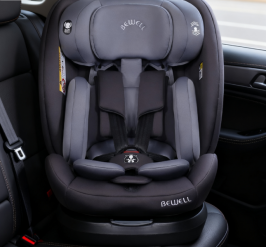
With the growing demand for family travel, children's car safety has become a core concern for parents. For newborn families, selecting the "first car seat" is even more crucial — it not only serves as a "mobile safety capsule" for babies during travel but also accompanies children from infancy to school age, adapting to the full height development stage of 40cm to 150cm. As a renowned Chinese manufacturer with over 10 years of experience in the children's car seat industry and serving customers in more than 30 countries worldwide, BEWELL, backed by authoritative certifications such as ECE R129 (i-Size) and ISO9001, as well as full-process production capabilities from R&D, mold making, injection molding to assembly, presents this scientific and detailed purchasing guide to help every family accurately find the right safety protection for their children.
I. Core Principle for Selection: Height is the Primary Hard Criterion
Many parents fall into the trap of "choosing by age" when selecting a car seat, but children's growth and development vary significantly individually. Height and weight are more scientific criteria. Combining global safety regulations and 10 years of export experience, BEWELL divides children's car travel stages into four height ranges, each corresponding to different seat types and core needs, allowing parents to directly match their children's conditions:
|
Height Range
|
Suitable Age
|
Corresponding Weight
|
Recommended Seat Type
|
Core Safety Requirements
|
|
40-150cm
|
0-12 Y
|
0-36kg
|
Rear-facing Infant Car Seat
|
Focus on protecting the head and neck, reducing cervical stress during collisions
|
|
76-150cm
|
9 M-12 Y
|
9-36kg
|
Reversible Car Seat Balance
|
rear-facing protection and forward-facing transition, enhance comfort
|
|
100-150cm
|
4-12 Y
|
15-36kg
|
Booster Car Seat
|
Increase seating height to adapt to vehicle seat belts
|
|
125-150cm
|
6-12 Y
|
20-36kg
|
Breathable Mesh Booster
|
Lightweight design, ensure shoulder belt fit
|
"Newborns are usually around 45cm tall, with extremely low cervical ossification. Rear-facing installation can disperse collision impact through the seat back, which is key to protecting the fragile head and neck," said BEWELL's Product R&D Director. According to ECE R129 regulations, infants under 76cm must use rear-facing seats with a recline angle of ≥110° — a standard integrated into the core design of BEWELL's entire range of infant seats.
II. Stage-by-Stage Purchasing Guide: Adaptive Solutions from Newborns to School-Age Children
1. Newborn Stage (40-76cm): Rear-Facing Installation to Protect "Fragile-Neck Babies"
A newborn's head accounts for 13% of their body weight, and the cervical spine is like a "soft noodle" lacking sufficient support. Shear force during collisions can easily cause severe injuries. When purchasing a seat for this stage, focus on the following 3 points:
Installation Method: Must choose a rear-facing seat, preferably fixed with ISOFIX connectors + top tether for more stability and reduced seat displacement during collisions. BEWELL's BW25 series infant seats are equipped with retractable ISOFIX guide slots, compatible with over 90% of household vehicles, allowing even first-time parents to install them quickly.
Recline Design: The recline angle should reach 150°—160°to ensure the baby's head fits closely to the back, dispersing impact to the entire torso. Through ergonomic curved design, BEWELL's seats in this series keep the newborn's sternal angle≤45°, ensuring unobstructed breathing while allowing the baby to sleep soundly during travel.
Material Safety: Seat fabrics must pass non-toxic testing to avoid irritating substances contacting the baby's delicate skin. BEWELL uses food-grade environmentally friendly fabrics that are odorless, highly breathable, and removable for machine washing, facilitating handling of unexpected situations such as baby's spit-up or diaper leaks.
2. Toddler Stage (76-100cm): Reversible Installation to Balance Safety and Comfort
When the baby reaches 76cm in height and can independently lift their head and sit up, the seat installation direction can be switched according to their development, but the duration of rear-facing protection should be extended as much as possible. Key purchasing points for this stage:
Reversible Installation Function: Choose a seat that supports free switching between rear-facing and forward-facing, such as BEWELL's BW26 series, which meets the long-term use needs of 9 months to 4 years old. It still provides 160°large-angle protection in rear-facing mode, and the backrest angle can be adjusted in forward-facing mode to adapt to the baby's different states such as playing or resting.
Side Impact Protection System: Toddlers are more active, so side collision risks require special prevention. This series of seats features built-in EPS foam side impact protection modules, which absorb lateral impact force during collisions and reduce toddler's torso displacement, meeting ECE R129 side collision test standards.
Adjustment Convenience: The headrest should support multi-level adjustment, synchronously raising with the baby's height growth to ensure the head is always in the optimal protection position. BEWELL's seat headrest adopts a one-key adjustment design, allowing height adaptation without disassembly, simple and efficient to operate.
3. Preschool Stage (100-125cm): Booster Transition to Adapt to Vehicle Seat Belts
After children around 4 years old exceed 100cm in height, their cervical spine development is gradually improved, but they still need to use a booster seat to increase seating height, allowing the vehicle's seat belt to fit accurately on the shoulders and hips, avoiding the belt strangling the neck or abdomen. Notes for purchasing:
Seat Structure: Choose a booster car seat with a backrest instead of a simple booster cushion. The backrest can provide support for the child's back and head, reducing fatigue during long-distance travel. BEWELL's seats for this stage adopt an integrated injection-molded shell, which is structurally strong while maintaining a lightweight design for easy carrying by parents.
Seat Belt Guidance: Equipped with shoulder belt guide slots to ensure the vehicle's seat belt fits the child's shoulders accurately, avoiding abdominal injury risks caused by excessively low belt position. The height of the guide slots should be adjustable to meet different height growth needs.
Comfort Configuration: Seat fabrics can be breathable mesh to enhance air circulation and prevent children from feeling stuffy during long rides. BEWELL's BW15 series booster seats are equipped with breathable mesh fabrics and optimized cushion curvature to fit children's hip curves, improving seating comfort.
4. School-Age Stage (125-150cm): Lightweight Booster Cushion for Both Safety and Convenience
After children over 6 years old reach 125cm in height, their physical development is close to that of adults, and lightweight booster cushions can be used to allow the vehicle's seat belt to directly exert a protective effect. Core purchasing points for this stage:
Fit: The height of the booster cushion must ensure the child's shoulders are level with the vehicle's seat belt, and the lap belt fits the root of the thighs. BEWELL's BW28B2 series booster cushions adopt an ergonomic design that naturally guides the seat belt position to avoid misaligned protection.
Safety: The shell should be made of high-strength ABS material, and the bottom is equipped with non-slip silicone strips to prevent the booster cushion from shifting during travel. This series of products has passed ECE R44/04 certification, and its anti-slip performance in collision tests far exceeds industry standards.
Portability: School-age children travel frequently, so the booster cushion needs to be lightweight and easy to store. BEWELL's booster cushion weighs only 2.5kg and features a foldable design, convenient for parents to carry to relatives' vehicles or during travel.
III. Conclusion: Choose the Right "First Seat" to Protect Every Kilometer of Growth
From 40cm newborns to 150cm school-age children, every height increase of the child means a change in car safety needs. The core of choosing a children's car seat is "adaptation" — adapting to height and weight, adapting to the vehicle model, and adapting to usage scenarios. Adhering to the concept of "Designed for Safety, Manufactured for Durability", BEWELL integrates global regulatory standards such as ECE R129 into every detail of product design, and provides comprehensive travel solutions covering the 40-150cm height range for families worldwide through full-process production control and customization services.
As parents, there's no need to pursue expensive "one-size-fits-all" seats. Instead, choose scientifically according to the child's growth stage to ensure professional safety protection for every journey. If you still have questions, visit BEWELL's official website (https://www.nbbewell.com) to query more product details and purchasing knowledge, or contact brand customer service for one-on-one consulting services, so that your baby's "first car seat" is chosen with confidence and used with peace of mind.